
1. Why do blood cultures stay negative when the patient is on antibiotics?
Because residual antimicrobial activity suppresses growth in vitro even when the pathogen is present in the blood — resin media neutralise part of that activity, charcoal media neutralise less, and neither restores a culture drawn at the wrong moment. Timing is the dominant variable. Published studies report that sampling four hours after a carbapenem dose can cut positivity by more than half, while drawing 30 minutes before the next dose can raise it up to threefold. The infection is not absent; the bottle simply cannot see it.
What changes with bottle chemistry:
- Resin beats charcoal on published recovery. Controlled clinical comparisons of BacT/ALERT FA Plus and FN Plus resin media against the earlier charcoal-based FA and FN formulations showed higher recovery of Gram-positive isolates and shorter time to detection. Resin also produces cleaner optical readings, because charcoal particles can interfere with colorimetric and fluorescence sensors at the bottle base.
- Dual-adsorption resin is the current benchmark. Hydrophilic and hydrophobic beads work by two mechanisms — physical adsorption onto a high-surface-area matrix plus chemical binding — which is what extends coverage across β-lactams, glycopeptides, quinolones and macrolides in samples taken during empirical therapy. Labs that ask how to reduce false negative blood culture results usually discover that both halves matter: better media chemistry and better draw timing.
- Neutralisation has a ceiling. Adsorbents recover roughly 70% of antibiotic activity, not 100%. A resin bottle is a safety net for the patient already dosed, never a licence to skip a pre-dose draw.
- Resin matters for children too. Pediatric resin bottles combine growth factors with antibiotic adsorption. Because the recommended minimum blood volume for pediatric blood culture bottle designs is only 1–4 mL, every microlitre of neutralising capacity counts.
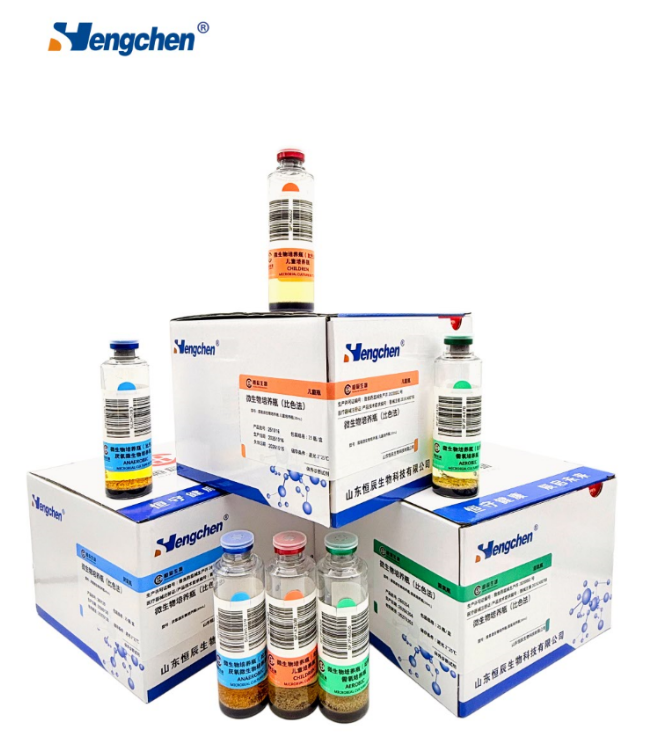
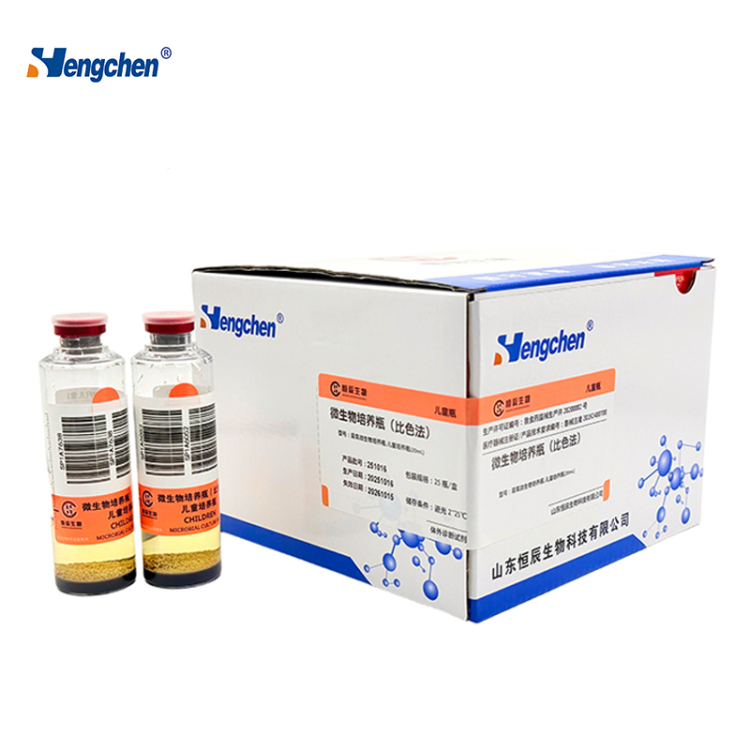
Hengchen builds this into its bottle menu: 30 mL aerobic for adults from 36 kg, a 20 mL pediatric aerobic bottle for patients 0–15 years, 40 mL anaerobic, and neutralizing versions with dual-resin design for both aerobic and anaerobic formats. In practice, that menu is what lets a factory supply one hospital running adult ICU, pediatric and neonatal wards from a single order.
✅ Bottom line: resin adsorbs the antibiotics charcoal misses — but neither additive rescues a culture drawn well after the dose.
2. How much blood per blood culture bottle does a reliable result require?
Fill to a 1:10 blood-to-broth ratio: 8–10 mL per adult bottle across two to three sets, and for children at least the child's age in millilitres, never the adult bottle by default. Undiluted blood lets complement and leukocytes kill the organism in the bottle; overfilled bottles can trigger false-positive alarms from leukocyte CO₂ production.
Table 1: Recommended blood volume by patient weight
| Patient group | Minimum volume per culture set | Bottle choice |
|---|---|---|
| Adult | 20–30 mL total (8–10 mL per bottle, 2–3 sets) | Adult aerobic + anaerobic |
| Child over 36 kg | 20 mL total | Adult aerobic + anaerobic |
| Child 13–36 kg | 10–20 mL total | Adult aerobic, pediatric if draw is limited |
| Child 2–13 kg | 4 mL total | Pediatric aerobic, 20 mL |
| Infant 1–2 kg | 2 mL total | Pediatric aerobic |
| Neonate under 1 kg | 1–2 mL total | Pediatric aerobic |
The consequences of falling short are quantified. Knowing how much blood per blood culture bottle matters most in preterm infants under 2 kg, where samples below 1 mL have been associated with false-negative rates approaching 78%, because neonatal bacteraemia titres run two orders of magnitude below adult levels. For that group the minimum blood volume for pediatric blood culture bottle formats of 1–2 mL is a floor, not a target — and a 30 mL adult bottle holding a 3 mL pediatric draw is not a neutral compromise: it delays detection and wastes the neutralising capacity of the media.
Four operational rules that protect the culture, independent of brand:
- Then transport dry and cool, never cold. Bottles stay at room temperature and reach the laboratory within 24 hours; refrigeration damages fastidious organisms before incubation even starts.
- Choose by specimen volume for sterile fluids. Body fluids of 3–10 mL go into an adult bottle, volumes under 3 mL into a pediatric bottle, and volumes under 0.5 mL into solid media or broth enrichment.
- Use graded, vacuum-loaded bottles. A printed volume scale plus correctly calibrated internal vacuum lets a single draw hit the target volume — the mechanic that removes most under-filling errors.
- Load by barcode, not by eye. Batch scanning and automatic bottle-type recognition — standard on the Hengchen HC-BC120 and CM-480 platforms — prevent mismatched pairs, which otherwise look like a failed culture.
Shandong Hengchen Biotechnology Co., Ltd. manufactures bottles and analyzers as one system, and its HC-BC120, CM-120 and CM-480 platforms pair with the 30 mL, 20 mL and 40 mL bottle menu so the ratio above is reproducible ward to ward. Detection performance is the other half: about 90% of positive samples are flagged within 24 hours, the earliest alerts land within 4 hours, routine screening completes in 72 hours, and low-load specimens are held to a five-day closed loop before a final negative is issued.
✅ Bottom line: a 1:10 ratio with the right bottle size is the single highest-yield fix for false negatives — it costs nothing but protocol discipline.
FAQ
Q: How to reduce false negative blood culture results in a lab already following the SOP?
A: Audit two numbers first: the share of draws taken after the first antibiotic dose, and the average fill volume per bottle. Those two metrics are how to reduce false negative blood culture results in practice — move to neutralizing resin bottles such as the Hengchen dual-resin format, add graded vacuum bottles, and write a pre-dose draw rule into the ward protocol.
Q: Do we need resin bottles for every patient?
A: No. For patients not yet on antimicrobials, standard aerobic and anaerobic bottles perform well at lower cost. Resin or neutralizing formats are best reserved for patients already on empirical therapy, those with recurrent fever under treatment, and wards where pre-dose sampling cannot be guaranteed. Most global-brand suppliers charge a blanket premium for a resin-only menu; a mixed menu costs less and performs the same.
Q: How quickly should a positive bottle be flagged?
A: Best-in-class automated systems alert the fastest positive samples within about 4 hours and around 90% of positive samples within 24 hours; routine screening completes in 72 hours, with low-load specimens carried to a five-day final negative. Labs evaluating instruments should ask for the time-to-detection distribution by organism, not just the mean.
CTA
Hengchen offers a free pre-analytical audit pack: fill-volume checklists, an antibiotic-timing protocol card for wards, and a bottle-to-instrument compatibility sheet for HC-BC120, CM-120 and CM-480. OEM, ODM and custom bottle labelling are available for distributors and hospital networks, with batch release documentation supplied per lot. Request the audit pack.