
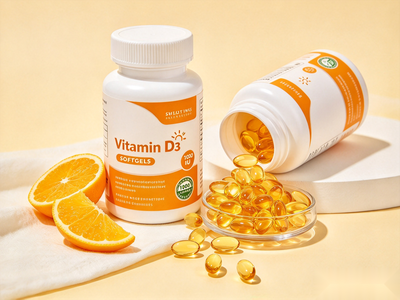
Vitamin D3 comes in almost every supplement format you can think of—tablets, capsules, drops, gummies and softgels. But vitamin D3 softgels remain one of the most common choices.
There is a practical reason for that.
Vitamin D3, also called cholecalciferol, is fat-soluble. In a softgel, it can be dispersed in a small amount of carrier oil and sealed inside a compact capsule. It is a simple format, but one that fits the ingredient particularly well.
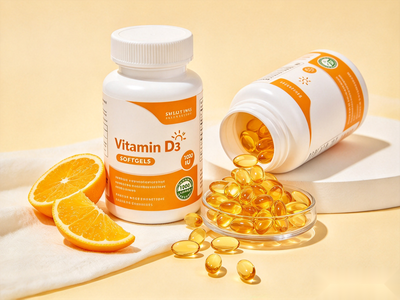
What Is Inside a Vitamin D3 Softgel?
A typical vitamin D3 softgel does not need a long ingredient list.
The fill usually contains vitamin D3 and a carrier oil. Depending on the formula, that oil might be sunflower oil, safflower oil, olive oil or another suitable edible oil.
Around the fill is the softgel shell, commonly made from gelatin, glycerin and water.
So while two bottles may both say “Vitamin D3 Softgels” on the front, the products inside can still differ in several ways:
-
Vitamin D3 amount per softgel
-
Source and type of carrier oil
-
Capsule size
-
Shell formulation
-
Other added ingredients
These details are worth checking, especially when comparing products with similar-looking front labels.
Why Is Vitamin D3 Commonly Made as a Softgel?
Vitamin D is a fat-soluble vitamin. The NIH Office of Dietary Supplements notes that the presence of fat in the gut enhances vitamin D absorption.
That makes an oil-based format a natural fit.
In a softgel, vitamin D3 can be incorporated into an oil fill rather than a larger dry powder blend. Because the actual amount of vitamin D3 required per serving is small, the finished softgel can also be quite compact.
There is another practical benefit: consistency of format.
The liquid or semi-liquid fill is prepared first, then accurately dosed into the softgel during encapsulation. For a relatively straightforward ingredient such as vitamin D3, there is little reason to make the capsule unnecessarily large or the formula unnecessarily complicated.
Vitamin D3 Softgels vs Tablets
Both formats are widely used, and neither is automatically the right choice for every product.
| Vitamin D3 Softgels | Vitamin D3 Tablets | |
|---|---|---|
| Formula format | Usually oil-based | Usually a dry formulation |
| Capsule/tablet structure | Soft outer shell with liquid or semi-liquid fill | Compressed solid |
| Typical size | Often relatively small | Depends on formula and excipients |
| Production | Fill preparation, encapsulation and drying | Blending and compression |
| Formula options | Well suited to simple oil-based formulas | Useful for many dry and combination formulas |
For consumers, the difference may simply come down to which format they prefer taking.
From a formulation perspective, the distinction is more meaningful. A softgel allows D3 to sit in an oil-based fill, while a tablet requires the ingredient to be incorporated into a dry formulation with the materials needed for tablet production.
Understanding Vitamin D3 Softgel Strength
This is where similar-looking products can be very different.
Vitamin D3 amounts may be shown in micrograms (mcg), International Units (IU), or both. In the United States, 1 mcg of vitamin D is equivalent to 40 IU.
That means:
-
25 mcg = 1,000 IU
-
50 mcg = 2,000 IU
-
125 mcg = 5,000 IU
A 5,000 IU softgel is not simply a “better” version of a 1,000 IU product. They are different product specifications intended for different positioning and use cases.
For U.S. labeling, the FDA Daily Value for vitamin D is currently 20 mcg (800 IU) for adults and children aged 4 years and older.
The number on the front of the bottle therefore needs context. Serving size, intended consumer and label directions all matter.
Vitamin D3 Alone or D3 + K2?
Another common choice is whether to keep D3 on its own or combine it with vitamin K2.
Both approaches are common.
A standalone D3 softgel keeps the ingredient list short and makes the product immediately understandable. D3 + K2 creates a combination formula and gives brands another way to position the product.
From a manufacturing perspective, however, adding K2 is more than changing the name on the bottle. The additional ingredient affects the formulation, specification, sourcing and finished-product testing.
The decision should therefore start with the intended product—not with the assumption that more ingredients automatically make a better supplement.
What Matters When Developing a Vitamin D3 Softgel?
Vitamin D3 softgels can look like one of the simplest supplement products to manufacture. The specification still needs to be clear before production begins.
Potency
How much vitamin D3 should each softgel contain? This affects the product specification and labeling from the beginning.
Carrier oil
The oil is part of the actual formula, not just an inactive detail. Its source and suitability should be considered during formulation.
Softgel shell
Shell composition, capsule size and appearance need to match the finished product requirements.
Capsule size and fill weight
Vitamin D3 requires very little active material, so the formulation should be designed around an appropriate fill rather than making the softgel larger than necessary.
Testing
Raw-material verification and finished-product testing are important even for a simple formula. A finished-product Certificate of Analysis should correspond to the agreed specification.
Packaging
Bottle size, count per bottle, label format and outer packaging can all be adjusted according to the market and brand positioning.
These decisions are usually more important than trying to make a basic D3 formula look complicated.
Simple Product, but the Details Still Matter
The popularity of vitamin D3 softgels is not difficult to understand. Vitamin D3 is fat-soluble, the oil-based fill suits the ingredient, and the finished capsule can remain small and straightforward.
But “Vitamin D3 Softgels” is still only the product category.
Potency, carrier oil, shell composition, testing and packaging determine what the actual finished product will be.
For brands developing a private-label vitamin D3 product, Jiabei Health can manufacture standalone D3 softgels as well as combination formulas such as D3 + K2, with specifications and packaging developed around the intended market.
FAQ
Are vitamin D3 softgels usually oil-based?
Yes, many vitamin D3 softgels use an oil-based fill. Vitamin D is fat-soluble, which makes oil a practical carrier for this type of formulation.
What is the difference between vitamin D3 softgels and tablets?
Softgels usually contain D3 dispersed in an oil-based liquid or semi-liquid fill, while tablets use a compressed dry formulation. Both can deliver vitamin D3, but their formulation and manufacturing processes are different.
Is vitamin D3 the same as cholecalciferol?
Yes. Cholecalciferol is the chemical name commonly used for vitamin D3 in supplement ingredient lists and technical documentation.
Why do some vitamin D3 softgels also contain vitamin K2?
Some products combine D3 and K2 as part of a broader formula rather than selling vitamin D3 as a single ingredient. This creates a different product specification and positioning rather than simply a higher-strength version of a standard D3 softgel.