
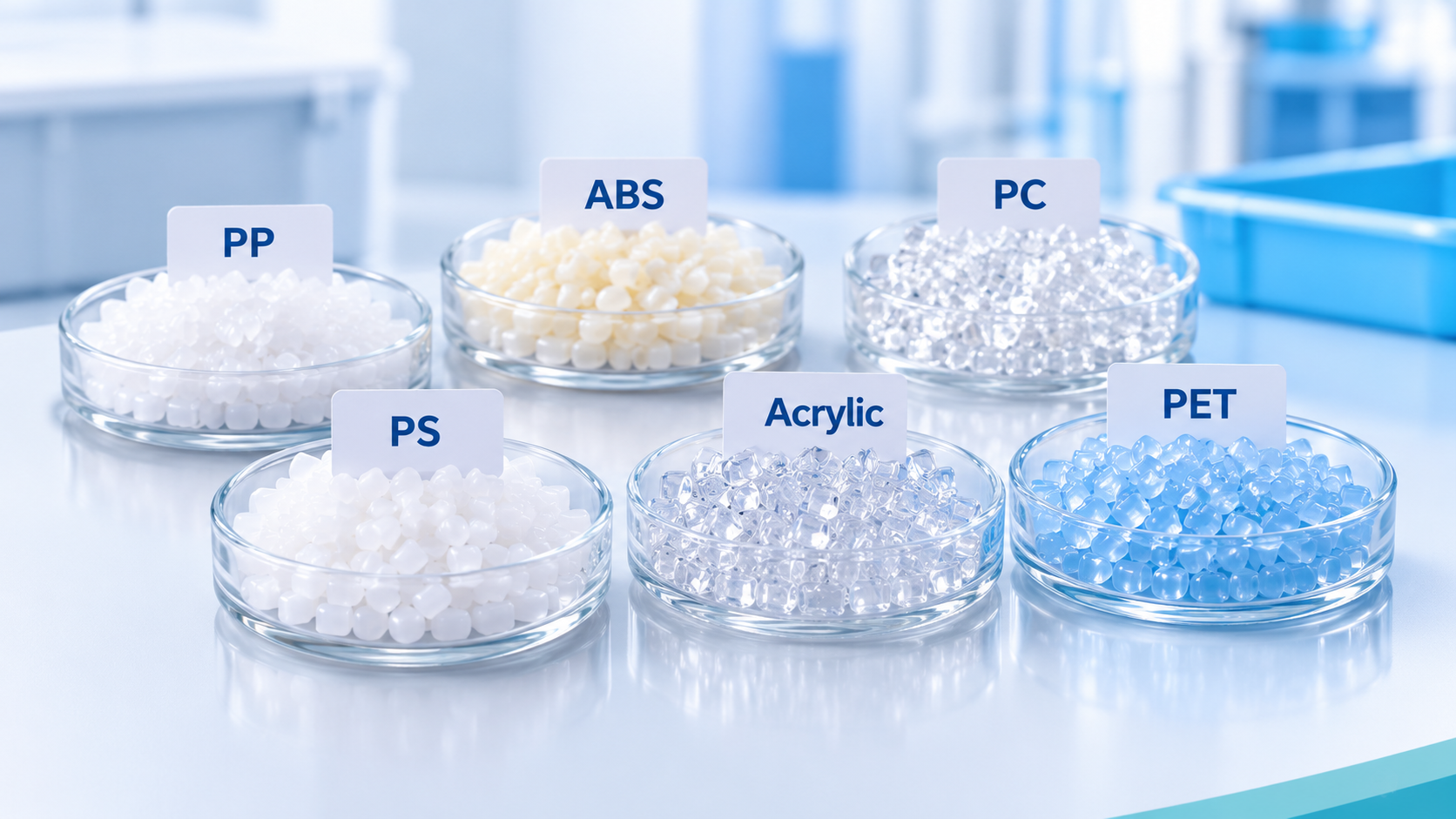
Storage bins, drawer organizers, trays, and clear holders are common in treatment preparation rooms. They may all look like “plastic,” but they can feel and perform differently. Some are lightweight, some handle bumps better, and some make it easier to see what is inside.
Product descriptions often mention PP, ABS, PC, PS, acrylic, or PET. You do not need to memorize every technical name. Start with three questions: What will the product hold? How will it be used? How will it be cleaned?
Six materials at a glance
| Material | Common characteristics | What to check for medical storage |
|---|---|---|
| PP | Lightweight; commonly used for bins and trays | Load capacity, cleaning instructions, and temperature limits |
| ABS | Rigid; often used for organizer bodies and components | Wear on frequently opened parts and cleaner compatibility |
| PC | Can be clear and resists impact relatively well | Scratches, cleaner compatibility, and temperature limits |
| PS | Lightweight; may suit items that stay in one place | Risk of cracking under impact or heavy loads |
| Acrylic | Very clear, making contents easy to see | Impact resistance and cleaner compatibility |
| PET | Commonly used in clear plastic products | Do not assume it can withstand hot water; check the product instructions |
These are general characteristics. Two products made from the same type of plastic can still perform differently because of their design and manufacturing.
Will the stored items touch the plastic?
If a container holds individually packaged supplies, consider whether staff can find and remove them easily, whether the container supports the load, and whether it can be cleaned as required.
If medication or other items will touch the plastic directly, confirm that the specific finished product is suitable for that use. A material label such as “PP” is not enough to establish suitability.
Does a plastic smell mean it is unsafe?
A new plastic product may have an odor from its packaging or manufacturing process. An odor alone does not prove that a product is unsafe, and no odor does not prove that it is suitable for every use.
If a strong smell persists, or a new smell appears after cleaning, pause use and ask the supplier about it. Check for discoloration, warping, or cracks at the same time.
Can it be washed with hot water or sterilized with heat?
Check the finished product’s instructions. Even if two containers are both labeled “PP,” differences in thickness and design may affect how they respond to heat.
Before using hot water, steam, or heat based equipment, confirm that the manufacturer explicitly allows that method for the product.
How long will a plastic organizer last?
There is no fixed lifespan that applies to every plastic storage product. Frequent handling, weight, impacts, and cleaning methods all affect its condition.
Regular inspection is more useful than relying on a number of years. Consider replacing an organizer if it has cracks, sharp broken edges, lasting deformation, a lid that no longer closes properly, or a surface that can no longer be cleaned as required.
Five questions to ask before buying
- What will it hold? Will the contents touch the plastic directly?
- Will it stay in one place or be moved and opened frequently?
- Is it more important to see the contents or to resist bumps?
- Which cleaners does the facility use, and are they compatible?
- Will the product be exposed to hot water or heat based sterilization?
The right medical storage product is one that fits its specific task and working environment. Sishubanghu uses virgin plastic materials to make its medical storage products, with a focus on material quality and safe everyday use.