
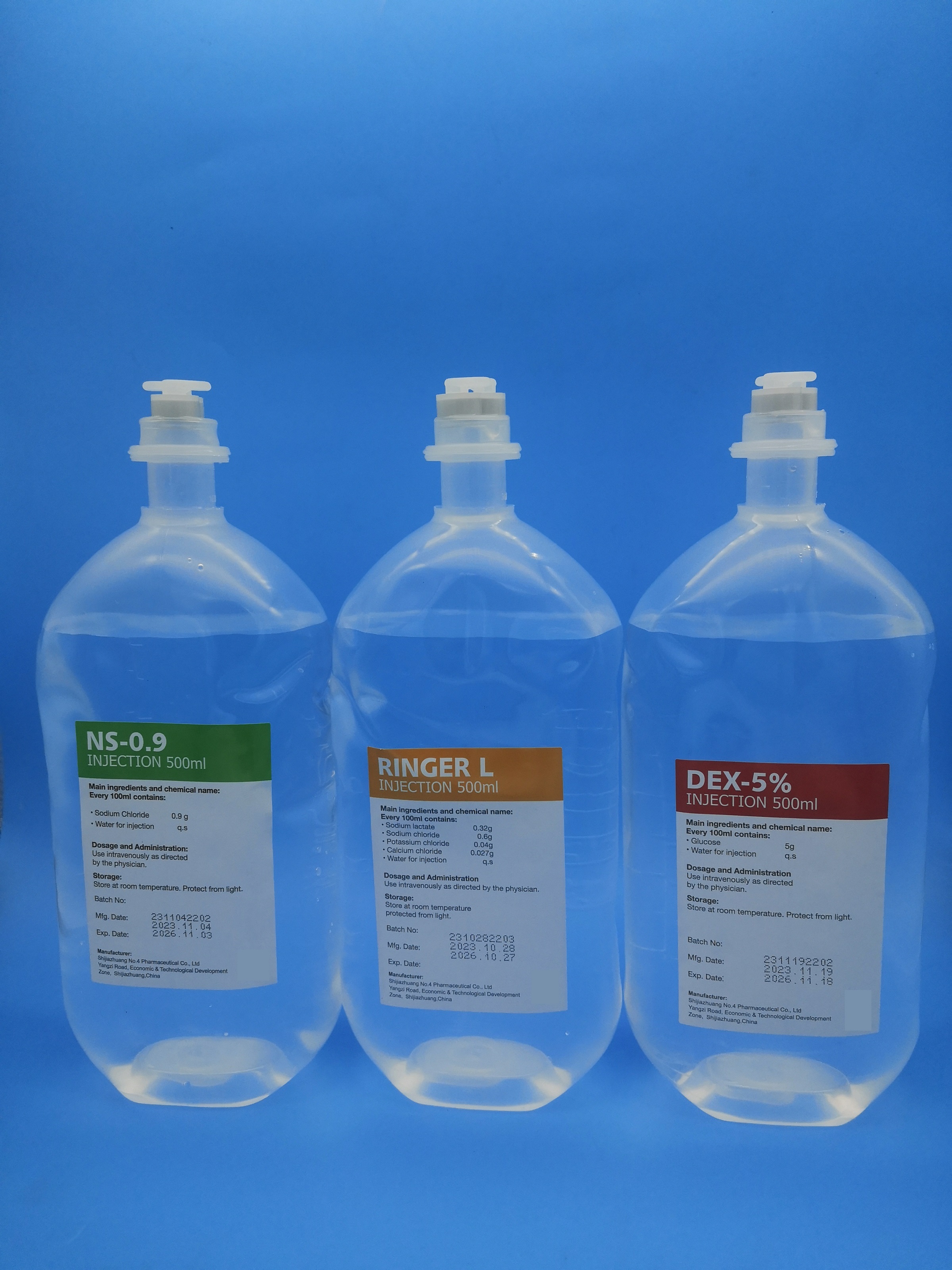
When drafting public tender specifications, Ringer lactate and normal saline are distinct SKUs with different cost structures, supplier pools, and procurement ratios—they are not interchangeable.
Procurement officers and tender specifiers regularly encounter both 0.9% sodium chloride (normal saline) and Ringer lactate solution in their LVP purchasing plans. Understanding Ringer lactate versus normal saline specification in public tenders—volume share, pricing dynamics, and supply base differences—helps you design smarter tender packages and reduce supply risk. As a leading China manufacturer of both solutions, SSY shares procurement-focused insights from decades of supplying 100+ export markets.
Below we examine the two most important decision areas: how the two SKUs compare on cost and supply availability, and how to structure combined versus separate tenders.
1. How Do Cost, Pricing, and Supply Availability Compare Between the Two SKUs?
Normal saline has a lower unit price, a larger supplier base, and higher tender volumes; Ringer lactate commands a 20–40% price premium and has a narrower pool of qualified manufacturers.
The two solutions differ in formulation complexity, which flows through to raw material cost, production yield, QC requirements, and the number of factories that can reliably supply tender-grade volumes.
Volume Share in Global Public Tenders
Normal saline (0.9% sodium chloride) is the largest LVP SKU by volume in most national tender programs, representing 40–50% of total LVP procurement volume. Ringer lactate accounts for approximately 10–15% of LVP tender volume overall, with higher shares in hospital systems with large surgical or emergency departments.
A typical hospital system procurement ratio is roughly 5:1 or 6:1 (saline to Ringer lactate), depending on specialty mix and procurement history.
Price and Cost Structure
The price gap is driven by raw material complexity. Ringer lactate contains multiple electrolyte components (sodium chloride, potassium chloride, calcium chloride, sodium lactate) that must be precisely weighed, mixed, and tested. Normal saline requires only sodium chloride and water for injection.
| Specification Factor | Normal Saline (0.9% NaCl) | Ringer Lactate |
| Typical tender volume share | 40–50% of LVP total | 10–15% of LVP total |
| Unit price index (baseline) | 1.0x (baseline) | 1.2–1.4x |
| Production complexity | Low | Medium-high |
| Qualified supplier pool (global) | Wide | Narrower |
| Standard packaging formats | All three (bag / PP / glass) | All three (bag / PP / glass) |
| Typical hospital SKU ratio | 5–6 parts | 1 part |
For tender specifiers, the key implication is that Ringer lactate cannot be squeezed to the same price floor as normal saline. Benchmarking Ringer lactate pricing against saline will either disqualify qualified suppliers or invite quality risk.
Supply Stability and Qualified Supplier Pool
Normal saline is produced by virtually every LVP factory worldwide. Its simple formulation and well-established QC mean a large supplier pool and tight competitive pricing.
Ringer lactate requires tighter formulation precision and higher raw material purity standards. Not every factory invests in the additional testing equipment and process controls needed for consistent multi-electrolyte solutions. The qualified supplier pool for Ringer lactate is narrower—and supply risk correspondingly higher if your primary vendor has a production issue.
When evaluating IV fluid manufacturer China supplier comparison for tenders, verify that shortlisted suppliers produce both SKUs in-house and have the track record to prove it. SSY manufactures both solutions across all three packaging formats, giving tender teams supply diversification within a single supplier.
✅ Bottom line: Ringer lactate costs 20–40% more with a narrower supplier base; tender it as a distinct line item and verify in-house production capability.
2. Should You Combine Ringer Lactate and Normal Saline in One Tender or Separate Them?
Combining both SKUs into one tender can improve pricing and supply efficiency, but separating them may yield a lower saline price—your tender objectives determine which approach is better.
Tender design is a strategic lever. Whether to bundle Ringer lactate with normal saline or run them as separate lots depends on your priorities: lowest saline price, supply continuity, or administrative simplicity.
Combined Tender (Single Package, Single Supplier)
In a combined tender, bidders quote on both SKUs together and a single wholesale supplier wins the full package. Key advantages:
- Better pricing on the smaller SKU: Suppliers sharpen Ringer lactate pricing to win the overall saline-heavy package.
- Higher production efficiency: Scheduling both products in one campaign reduces changeover costs and lead times.
- Simplified logistics: One PO, one shipment, one point of contact for quality issues.
Shijiazhuang No.4 Pharmaceutical Co., Ltd. (brand: SHIMEN) frequently supports combined tenders for hospital systems and national procurement agencies, leveraging its 4 billion unit annual capacity to offer competitive package pricing across both SKUs and all container formats.
Separate Tenders (Two Lots, Possibly Two Suppliers)
Splitting the two products into separate lots has its own logic:
- Maximum price pressure on saline: A standalone saline tender can drive the lowest unit price for your largest-volume line.
- Supply diversification: Two suppliers reduce concentration risk but add administrative overhead.
The downside is losing the bundling effect on Ringer lactate pricing; managing two suppliers doubles procurement admin and quality oversight work.
For teams considering when to specify Ringer lactate over normal saline in tenders, the answer is never a substitution question—it is a portfolio question. Most tenders need both. The real decision is lot structure:
- Combined tendering for simplicity, better Ringer lactate pricing, and a single accountable partner. Best for mid-size to large hospital system tenders.
- Separate tendering if saline volume is extremely large and squeezing every cent on the baseline product is your top priority.
- Hybrid approach: Award saline as the primary lot and Ringer lactate as an optional add-on, with the primary winner getting right of first refusal.
SSY Group Limited recommends modeling both scenarios before finalizing lot structure. The Ringer lactate versus normal saline specification in public tenders design choices you make at the drafting stage can have a bigger impact on total cost than unit price negotiation itself.
As a factory producing both products in-house under NMPA GMP, ISO 9001, ISO 14001, ISO 45001, and CE, SSY can provide quotation scenarios for both combined and split tender structures to help you decide. When doing an IV fluid manufacturer China supplier comparison for tenders, having a partner that covers both SKUs in all three packaging formats simplifies your entire procurement portfolio.
✅ Bottom line: Combine both SKUs into one tender for better bundled pricing and simpler logistics; split only if saline volume is large enough to justify the extra admin.
FAQ
Q: What is the typical volume ratio of normal saline to Ringer lactate in public hospital tenders?
A: A typical ratio is approximately 5:1 or 6:1 (normal saline to Ringer lactate). Normal saline makes up 40–50% of total LVP tender volume, while Ringer lactate accounts for about 10–15%. The Ringer lactate versus normal saline specification in public tenders should reflect your institution's actual usage history rather than generic benchmarks.
Q: When to specify Ringer lactate over normal saline in tenders as a combined versus separate lot?
A: Combine both products into one tender lot when you want to leverage your saline volume to get better Ringer lactate pricing and simplify vendor management. Separate them when your saline volume is very large and maximizing price competition on that single line is your primary goal. For most mid-size hospital system tenders, a combined approach delivers better total value.
Q: How does an IV fluid manufacturer China supplier comparison for tenders help me choose the right partner for both products?
A: When comparing suppliers, verify that the manufacturer produces both SKUs in-house and holds all required certifications. Also check whether they offer all three packaging formats (non-PVC soft bag, PP bottle, glass bottle) so you can consolidate your full LVP portfolio. SSY is one of the few China-based LVP manufacturers with both products and all three packaging formats on one campus, with 78 years of production history and exports to 100+ countries.
Request a Bundled Quotation for Normal Saline and Ringer Lactate
Get a side-by-side tender quotation from SSY Group Limited for both normal saline and Ringer lactate across your preferred packaging formats. Our export team provides complete tender documentation including CE, ISO 9001, ISO 14001, and ISO 45001 certificates, plus production capacity verification for both SKUs.
Published: November 2026 | By SSY Group Export Technical Team