
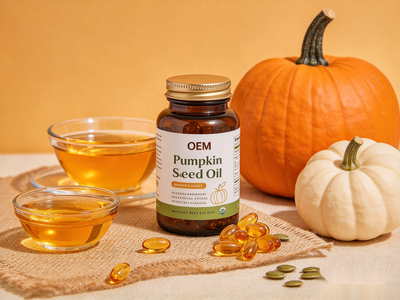
Pumpkin seed oil softgels sound like a simple product: pumpkin seed oil sealed inside a soft capsule.
And in many cases, they are.
But two bottles labeled “Pumpkin Seed Oil” can still be quite different. The amount of oil, serving size, other ingredients, shell composition and product specifications can all vary.
There is also another source of confusion: pumpkin seed oil and pumpkin seed extract are not the same ingredient. That difference matters when you compare products—or develop one for your own brand.
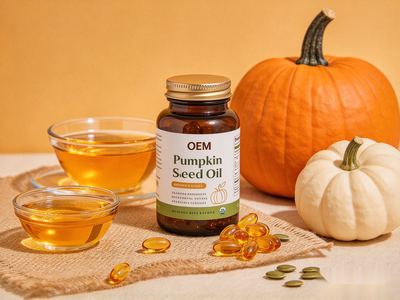
Pumpkin Seed Oil and Pumpkin Seed Extract Are Not the Same Thing
This is a useful distinction to make first.
Pumpkin seed oil is the oil obtained from pumpkin seeds. Because it is already an oil, it can be used as the liquid fill inside a softgel.
Pumpkin seed extract is different. It is typically supplied as a dry ingredient with its own specification and is more naturally suited to a hard capsule, tablet or powder-based formula.
So a label that says:
Pumpkin Seed Oil 1,000 mg
is describing something different from:
Pumpkin Seed Extract 1,000 mg
The numbers may look comparable, but the ingredients are not interchangeable simply because they come from the same plant.
For anyone comparing supplement labels, this is more useful than looking at milligrams alone.
Why Pumpkin Seed Oil Fits the Softgel Format
Some ingredients have to be mixed with a carrier oil before they can be used in an oil-based softgel.
Pumpkin seed oil starts as an oil.
That makes the relationship between the ingredient and dosage form fairly straightforward:
Pumpkin seed oil → liquid fill → softgel encapsulation
The oil is prepared according to the product specification and accurately filled into the softgel shell during encapsulation. The capsules then go through drying, inspection and the required quality checks before packaging.
There is no need to convert the oil into a dry powder simply to put it into a capsule.
This is one reason softgels make sense for products built specifically around pumpkin seed oil.
What Does “1,000 mg Pumpkin Seed Oil” Actually Tell You?
Quite a lot—but not everything.
If a product provides 1,000 mg of pumpkin seed oil per serving, that tells you the total amount of oil in that serving. It does not tell you the entire formulation or specification.
For example, check whether the 1,000 mg comes from:
-
One softgel or multiple softgels
-
Pure pumpkin seed oil or an oil blend
-
A specific pumpkin seed oil source
-
A formula containing additional ingredients
Serving size is especially easy to miss.
One bottle might provide 1,000 mg in a single softgel. Another might list 1,000 mg per serving but define a serving as two softgels.
The front of the bottle can make these products look nearly identical. The Supplement Facts panel tells you more.
For a private-label project, the specification needs to go further still. “We want a 1,000 mg pumpkin seed oil product” is a starting point, not a complete manufacturing brief.
Pumpkin Seed Oil Softgels vs Pumpkin Seed Capsules
The words softgel and capsule are sometimes used loosely when people search for supplements. From a formulation perspective, however, there can be an important difference.
| Pumpkin Seed Oil Softgels | Pumpkin Seed Capsules | |
|---|---|---|
| Typical ingredient form | Liquid pumpkin seed oil | Powder or dry extract |
| Fill type | Oil-based | Dry material |
| Dosage form | Soft capsule | Usually hard capsule |
| Key specification | Oil amount and oil quality | Powder/extract specification |
| Production method | Liquid-fill softgel encapsulation | Dry powder capsule filling |
The important point is not that one is universally better.
They are simply different products.
If you specifically want pumpkin seed oil, a softgel is a natural dosage format for carrying that oil. If the formula is based on a dry pumpkin seed ingredient or extract, a hard capsule may make more sense.
This is also why comparing two products only by their milligram number can be misleading.
What Else Should You Check on a Pumpkin Seed Oil Softgel?
Once you know that the product actually contains pumpkin seed oil, there are a few more details worth checking.
Amount Per Serving
Look at both the amount of pumpkin seed oil and the serving size.
A large number on the front label means less if it requires several capsules to reach that amount.
Other Oils and Ingredients
Read the complete ingredient list.
Some formulas are deliberately simple, while others may combine pumpkin seed oil with additional oils or functional ingredients. Neither approach is automatically a problem, but they are not the same product.
Softgel Shell
The shell is part of the finished product too.
Traditional softgels commonly use gelatin, glycerin and water. Shell specifications may vary depending on the formulation, market requirements and brand positioning.
If requirements such as Halal or specific ingredient sourcing are important, they should be confirmed when the product is being developed rather than after production.
Product Testing
A familiar ingredient does not remove the need for quality control.
For a commercial product, the raw material and finished softgels should be handled against defined specifications, with appropriate testing and documentation.
For B2B buyers, the COA is therefore more useful than relying only on the marketing claims printed on the bottle.
From Pumpkin Seed Oil to a Finished Softgel
For a brand developing its own product, choosing pumpkin seed oil is only the first decision.
A usable manufacturing specification also needs to answer practical questions:
How much oil should each softgel contain?
This affects fill weight, capsule size and serving directions.
Is pumpkin seed oil the only active ingredient?
A standalone formula is different from a blend containing other oils or ingredients.
What shell specification is required?
Gelatin source and other shell requirements should be established early, particularly when the target market has specific requirements.
How many softgels will go into each bottle?
30, 60, 90 and 120-count products create different packaging and positioning options.
What testing and documentation are required?
Product specifications, COA requirements and market-specific documents should be agreed before commercial production.
These details turn “pumpkin seed oil softgels” from an idea into an actual product specification.
A Simple Product Still Needs a Clear Specification
Pumpkin seed oil is already an oil, which makes the softgel format a logical match. That simplicity is one of the format's strengths.
But simple does not mean every product is identical.
The oil source, amount per softgel, serving size, shell composition, additional ingredients and testing requirements all shape the finished product.
For consumers, that means looking beyond the number on the front of the bottle.
For private-label brands, it means defining those details before production begins.
Jiabei Health manufactures oil-based softgel products for private-label and OEM/ODM projects, including standalone and combination formulas. Pumpkin seed oil softgels can be developed around different fill specifications, capsule sizes, bottle counts and packaging requirements according to the intended product and market.
FAQ
What are pumpkin seed oil softgels?
Pumpkin seed oil softgels are soft capsules containing pumpkin seed oil as an oil-based fill. The exact amount of oil, serving size, shell composition and other ingredients vary by product.
Is pumpkin seed oil the same as pumpkin seed extract?
No. Pumpkin seed oil is an oil derived from pumpkin seeds, while pumpkin seed extract is a different ingredient form with its own manufacturing process and specification. The two should not be compared simply by looking at milligrams.
Why is pumpkin seed oil sold in softgels?
Pumpkin seed oil is already a liquid oil, so a softgel provides a practical way to encapsulate a measured amount without first converting it into a dry powder.
Does 1,000 mg mean one pumpkin seed oil softgel contains 1,000 mg?
Not always. The amount may be listed per serving, and a serving can contain more than one softgel. Check the serving size and Supplement Facts panel.
What should a brand specify when ordering private-label pumpkin seed oil softgels?
The product brief should define the pumpkin seed oil specification, amount per softgel, other ingredients if any, shell requirements, capsule size, bottle count, testing requirements and packaging. These details should be agreed before commercial production.