
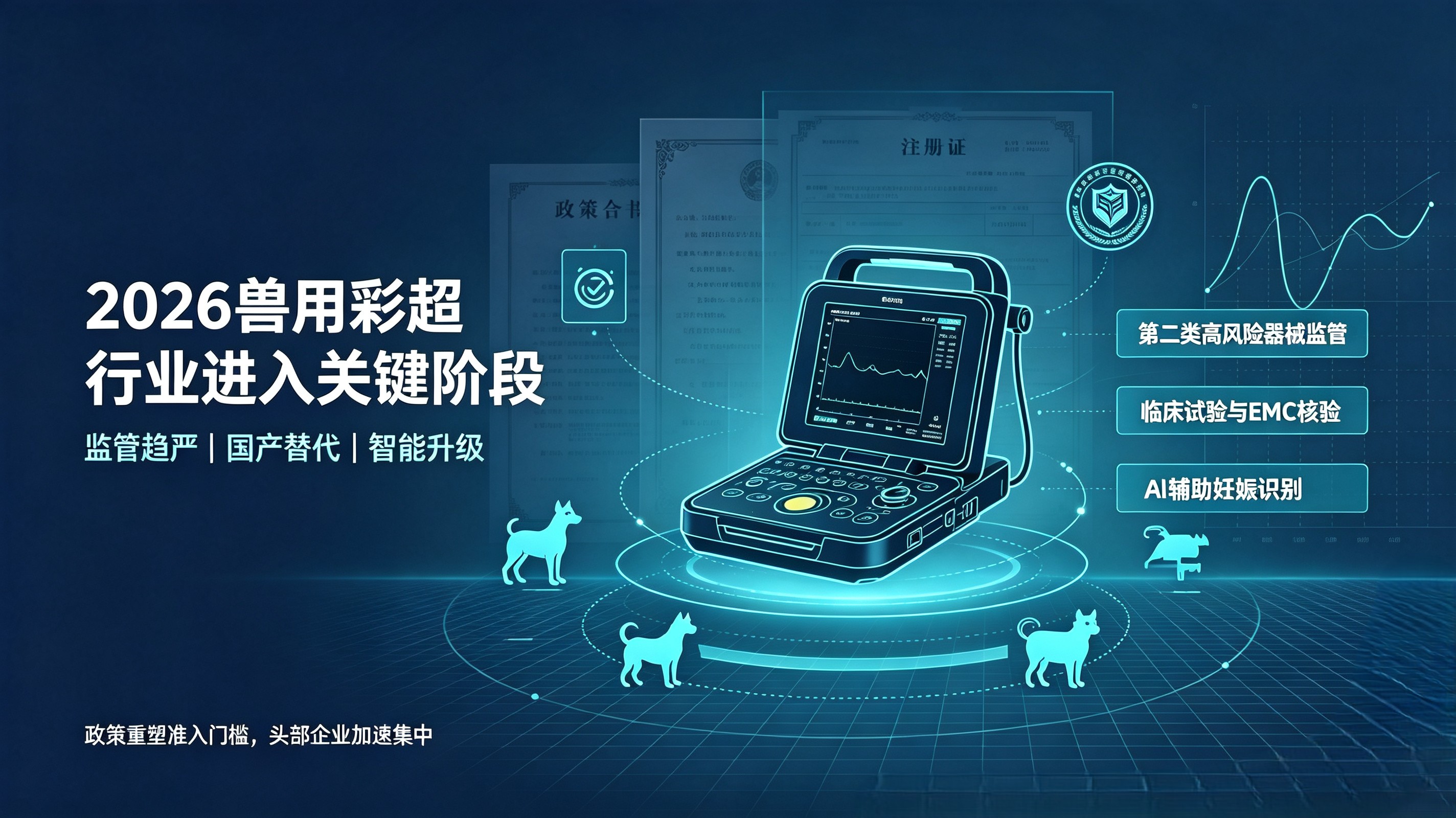
In 2026, the veterinary color ultrasound industry in China enters a critical phase featuring stricter regulatory governance and accelerated domestic substitution, with successive policies reshaping market access thresholds, product quality standards and industrial development layout.
From the regulatory perspective, the updated Classification Catalogue of Veterinary Medical Devices officially categorizes veterinary color Doppler ultrasound as Class II high-risk veterinary equipment under strict supervision. Meanwhile, the Guidelines for Registration Review of Animal Ultrasound Diagnostic Equipment has been fully implemented, transforming the review model from formal document checking to substantive performance verification. Manufacturers are required to submit complete clinical trial data targeting dogs, cats, livestock and poultry, as well as strict EMC safety test reports before obtaining registration certificates. These stringent rules have weeded out numerous small-scale manufacturers with low-quality, uncertified products; more than a dozen backward workshops have withdrawn from the market in the first half of the year, significantly boosting industrial concentration and eliminating disorderly low-price competition.
Supportive industrial policies strongly back domestic brand development. The Ministry of Agriculture and Rural Affairs rolls out special plans for the localization of high-end animal diagnosis equipment. Local governments launch financial subsidy programs for grassroots animal stations and pet clinics purchasing domestic veterinary color ultrasound, offering subsidies up to 12,000 US dollars per unit. This policy greatly stimulates end-users’ purchasing willingness, lifting the installation ratio of domestic ultrasound devices in tertiary animal hospitals year by year and breaking the long-term monopoly of imported overseas brands. Besides, the newly released group standard for veterinary ultrasound systems sets unified rigid indexes on image resolution, blood flow imaging precision and probe durability, filling the gap of unified industrial specifications. It pushes enterprises to focus on technological upgrades, with portable designs and AI-assisted automatic pregnancy identification becoming core R&D trends, perfectly matching scenarios including canine and feline gestation check, livestock breeding monitoring and exotic pet lesion screening.
On the market demand side, the booming pet economy drives robust equipment demand in urban pet clinics, while large-scale livestock farming fuels bulk procurement on breeding farms for regular pregnancy and health inspections. Overall, the veterinary color ultrasound industry now follows three major trends: tightened supervision, policy-supported high-quality enterprises and intelligent technological iteration. Non-compliant small players will keep being phased out, while leading manufacturers with independent R&D capability and complete registration qualifications will seize greater market share in both domestic and overseas markets.