
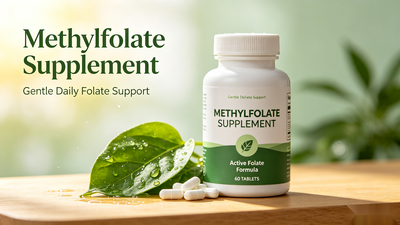
Pick up two methylfolate bottles and the labels may look surprisingly different.
One says 5-MTHF. Another says L-methylfolate. A third gives you a large number in mcg DFE, followed by a smaller number elsewhere on the label.
They may all be selling folate, or vitamin B9, but that does not mean you should compare them by the number printed largest on the bottle.
A good methylfolate supplement is easier to understand once you know what to look for: the actual folate form, the amount per serving, how DFE is declared, and what else is included in the formula.

There is also another side to this ingredient that rarely makes it onto consumer blogs. Methylfolate is usually present at a very small dose compared with the total weight of a capsule, tablet, gummy or powder blend. That makes ingredient handling and uniform distribution important when the product moves from a label concept to an actual production batch.
What Exactly Is Methylfolate?
Methylfolate is a form of folate, better known as vitamin B9.
Folate is needed for DNA synthesis and normal cell division. Supplements can provide it in different forms, including folic acid and 5-methyltetrahydrofolate, usually shortened to 5-MTHF. NIH recognizes 5-MTHF as one of the folate forms used in dietary supplements.
This is why several names appear when you shop for the ingredient.
You may see:
-
5-MTHF
-
L-5-MTHF
-
L-methylfolate
-
methylfolate
-
calcium L-5-methyltetrahydrofolate
The shorter names are convenient for marketing. The longer ingredient description matters more when you want to know what is actually in the formula.
Folic acid is also folate, but it is a different chemical form.
That distinction is worth understanding without turning it into a contest over which ingredient is "better."
Methylfolate vs. Folic Acid
Both methylfolate and folic acid provide vitamin B9.
Folic acid has a long history of use in supplements and fortified foods. 5-MTHF is a reduced form of folate that is now common in products positioned around methylated or active-form B vitamins.
| Methylfolate | Folic Acid | |
|---|---|---|
| Nutrient | Folate / vitamin B9 | Folate / vitamin B9 |
| Names commonly seen | 5-MTHF, L-5-MTHF, L-methylfolate | Folic acid |
| Chemical form | Reduced folate form | Synthetic oxidized folate form |
| Common applications | B-complex, multivitamins, standalone formulas | Supplements and fortified foods |
| Best way to compare | Check exact source, serving and DFE | Check serving, mcg and DFE |
The biochemical difference between them is real. The marketing conclusion that methylfolate must therefore be better for everyone is not.
That is particularly important when MTHFR enters the discussion.
Common MTHFR gene variants have helped drive consumer interest in 5-MTHF. But CDC's current guidance is clear that people with common MTHFR variants can process folic acid. CDC also continues to state that folic acid is the form proven to help prevent neural tube defects.
So a product should not be judged simply because the front label says "methylated."
A note for anyone who could become pregnant
This is one area where supplement marketing can become misleading.
FDA recommends that people who could become pregnant consume 400 mcg of folic acid daily from fortified foods, supplements, or both, in addition to folate obtained from the diet.
A prenatal product containing 5-MTHF should therefore not automatically be treated as equivalent to the evidence supporting folic acid for neural tube defect prevention.
What Those Methylfolate Names on the Label Mean
The terminology looks more complicated than it needs to be.
Here is a useful way to read it.
| Label term | What it tells you |
|---|---|
| 5-MTHF | Short for 5-methyltetrahydrofolate |
| L-5-MTHF | Specifies the L form used for supplementation |
| L-methylfolate | Another common name for L-5-MTHF |
| Calcium L-5-MTHF | A calcium salt form used as a supplement ingredient |
| Branded 5-MTHF source | Check the ingredient declaration for the actual chemical form |
This matters beyond consumer label reading.
A manufacturing formula cannot simply specify "methylfolate" and stop there.
The exact raw material affects the supplier specification, ingredient potency, batch calculation and label declaration. Two raw materials carrying similar consumer-facing names are not automatically interchangeable on a production sheet.
That is one reason experienced formulators work from the ingredient specification and COA rather than the marketing name alone.
Why Methylfolate Is Showing Up in More Formulas
Part of the growth is simply greater consumer attention to vitamin forms.
Someone comparing B-complex supplements today may look for methylcobalamin instead of just "B12," P-5-P instead of just "B6," and 5-MTHF instead of generic folate.
Methylfolate fits naturally into that market.
MTHFR awareness has also made the ingredient more recognizable. That does not mean an MTHFR result automatically determines which folate supplement a person should take. It means consumers are paying closer attention to folate chemistry than they did before.
From a product-development perspective, we commonly see methylfolate considered in formulas such as:
-
methylfolate + vitamin B12
-
methylated B-complex
-
multivitamins
-
prenatal formulas
-
iron + B-vitamin products
-
standalone 5-MTHF capsules
The best formula depends on what the product is supposed to be. Adding more supporting vitamins simply to make the Supplement Facts panel look fuller usually creates more formulation work without necessarily creating a clearer product.
The Number on the Label Can Be Misleading
This is the part many shoppers miss.
In the United States, folate is declared on Supplement Facts labels in micrograms of Dietary Folate Equivalents — mcg DFE. The Daily Value for adults and children age four and older is 400 mcg DFE.
So you may encounter a label that looks something like this:
Folate — 680 mcg DFE
from 400 mcg of 5-MTHF
At first glance, it appears as if the product somehow contains both 680 mcg and 400 mcg of the same vitamin.
It does not.
DFE is the labeling unit used to express folate amounts. The ingredient amount and its DFE declaration are related, but they are not necessarily printed as the same number.
There is an important detail here that is often missed in supplement articles.
For 5-MTHF, NIH says formal conversion factors between mcg of the ingredient and mcg DFE have not been established. FDA permits manufacturers to use a conversion factor of 1.7, comparable with supplemental folic acid, or an appropriately established factor that does not exceed 1.7.
That means you should not memorize one online methylfolate calculator and assume every product label must follow it exactly.
Instead, compare:
Serving size
Is the amount for one capsule or two?
Folate in mcg DFE
This is the regulatory declaration you will see on a U.S. Supplement Facts panel.
Actual folate source
Look for 5-MTHF, L-methylfolate or another identified form.
Amount of the source ingredient
Where disclosed, this helps you understand how the DFE figure relates to the ingredient used.
This is much more useful than comparing the largest number on two front labels.
Why Methylfolate Is Not Just Another Ingredient in Production
On paper, methylfolate can look almost insignificant.
Imagine a capsule formula weighing several hundred milligrams per unit while the target active is measured in micrograms.
Now scale that formula to a commercial batch.
The difference in magnitude becomes enormous.
This is precisely why a microgram-level ingredient should not simply be weighed and dropped into a large blender with the rest of the powder.
Even distribution matters.
A production approach may therefore include a concentrated premix followed by one or more dilution or blending stages before the material enters the final blend. The exact method depends on the formula, batch size, raw-material properties and manufacturing process.
The basic logic is straightforward:
Raw-material verification → weighing → premix → main blend → filling or compression → finished-product testing
The premix step is particularly important when several micronutrients are present at very different inclusion levels.
Think about a B-complex tablet.
Some ingredients may be present in milligram quantities. Others may be far lower. If the formulation and blending sequence are poorly designed, simply achieving the correct total amount in the blender does not guarantee that every finished unit receives a representative share.
This is where formulation stops being a spreadsheet exercise.
A low-dose active needs to work in a real production batch.
Capsules, Tablets, Gummies, or Drops?
Not every dosage form presents methylfolate in the same way.
Capsules
Capsules are often a practical choice for standalone methylfolate or compact B-complex formulas.
There is usually enough room to work with a carrier system or premix while keeping the ingredient list relatively simple.
Tablets
Tablets make sense when methylfolate is part of a broader multivitamin or B-complex.
The challenge is no longer only active distribution. Compression characteristics, flow, tablet weight and the behavior of the complete micronutrient blend also matter.
Gummies
A gummy may weigh several grams while methylfolate is required only at microgram levels.
That ratio alone tells you why "just add methylfolate" is not a useful development instruction.
Uniform incorporation, processing conditions, overage strategy where appropriate, flavor system and shelf-life performance all need to be considered as part of the finished gummy rather than as isolated ingredient decisions.
Liquid Drops
Liquid products bring a different set of questions.
The ingredient has to work in the actual liquid system. Solubility or dispersion, compatibility with other ingredients, concentration and stability over the intended shelf life need to be assessed before choosing the format simply because drops look convenient on a product page.
There is no universally superior delivery form.
The right format is the one in which the formula can be made consistently while still matching the intended serving, user experience and product positioning.
How I Would Compare Two Methylfolate Supplements
Ignore most of the front label for a minute.
Turn the bottle around.
First, identify the folate source.
Does the product actually specify 5-MTHF or L-methylfolate, or does the marketing language simply say "methylated B vitamins"?
Next, check the serving.
A higher-looking dose may require multiple capsules.
Then look at mcg DFE.
This is the U.S. folate labeling unit. FDA requires folate quantitative declarations on dietary supplement labels to use mcg DFE.
Read the rest of the Supplement Facts panel.
If you already use a multivitamin, B-complex or prenatal product, you may already be getting folate and other B vitamins.
Finally, resist potency marketing.
A bigger number does not tell you whether a supplement is more appropriate for you. High-dose products intended for specific circumstances should not be selected simply because the dose looks stronger.
From Supplement Label to Production Formula
Everything printed neatly on the finished Supplement Facts panel begins as a much messier collection of decisions.
For a brand developing a methylfolate supplement, we would want those decisions resolved before commercial production:
-
exact methylfolate raw-material form
-
supplier specification and potency
-
target amount per serving
-
DFE calculation
-
dosage form
-
other B vitamins or minerals in the formula
-
serving size
-
premix and blending approach
-
finished-product specification
-
label declaration
At Jiabei Pharma, this is the point where a good product idea needs to become a manufacturable formula.
A request such as "400 mcg methylfolate with B12 in a capsule" is enough to start a conversation. It is not enough to issue a production batch record.
The actual ingredient source, potency, capsule size, excipient system, batch scale and finished label all have to line up.
For methylfolate, the active itself may occupy very little physical space.
Getting that small amount right is the part that matters.
The Bottom Line
A methylfolate supplement should not be judged by the word "methylated" or by the largest number on the bottle.
Check the folate source. Read the full serving. Understand the mcg DFE declaration. Look at the other B vitamins already included.
And remember that methylfolate and folic acid are different forms of the same vitamin, not opposing camps where one must always be good and the other bad.
For supplement brands, there is one more layer: the ingredient has to survive the move from a formulation sheet to a repeatable commercial batch. With a microgram-level active such as methylfolate, raw-material selection, premixing, blend uniformity and label calculation deserve just as much attention as the marketing claim on the front of the bottle.
Frequently Asked Questions
Is 5-MTHF the same as methylfolate?
5-MTHF stands for 5-methyltetrahydrofolate and is commonly referred to as methylfolate. Labels may use more specific descriptions such as L-5-MTHF or L-methylfolate depending on the ingredient.
Why does a methylfolate label sometimes show two different mcg numbers?
One number may represent folate in mcg DFE, while another describes the amount of the folate source used in the product. For 5-MTHF, conversion factors are not formally fixed at a single value, so read the complete Supplement Facts declaration rather than assuming every product uses exactly the same calculation.
What does DFE mean?
DFE stands for Dietary Folate Equivalents. Folate is declared in mcg DFE on U.S. Nutrition and Supplement Facts labels, allowing folate amounts to be expressed using a standardized labeling framework.
Can methylfolate and vitamin B12 be used in the same supplement?
Yes. Methylfolate and vitamin B12 are commonly found together in B-complex and multivitamin formulations. The amounts and forms should be considered as part of the complete formulation rather than chosen independently.