
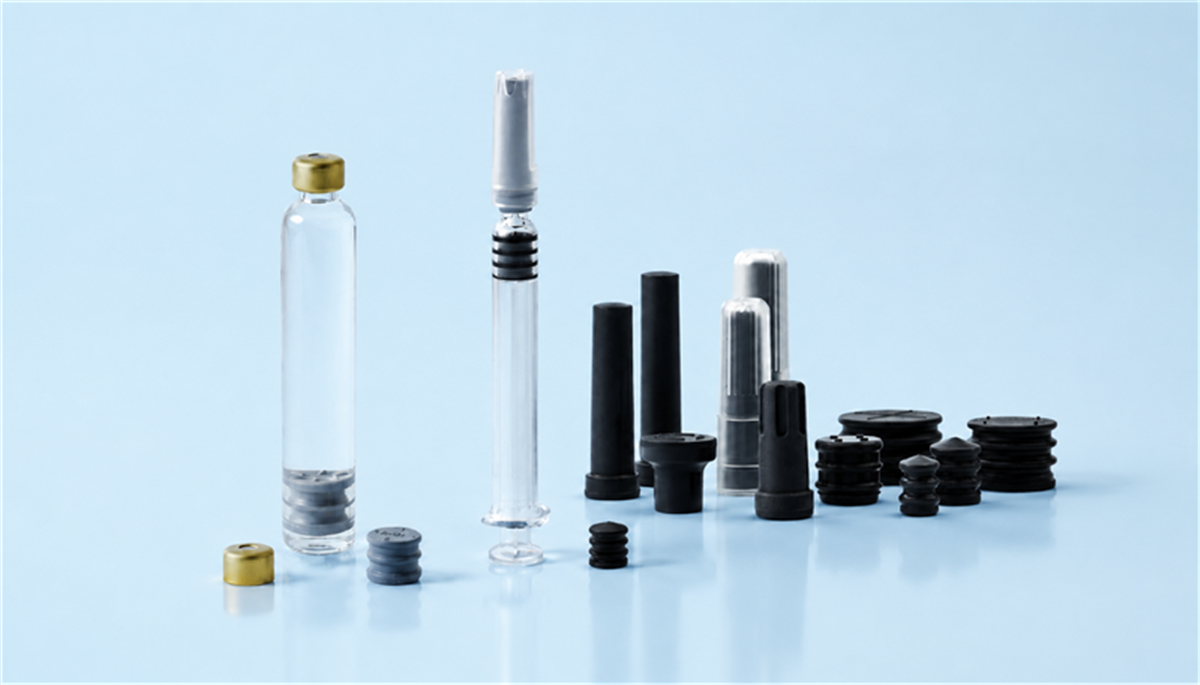
Buying the right lyophilization stopper is more complicated than ordering "bromobutyl stoppers" and calling it a day. The stopper is one of the most consequential component decisions for a freeze-dried product — get it wrong and you face moisture-related stability failures, stopper pop-out during lyo cycles, visible particulate on the cake, or rejected regulatory submissions.
This lyophilization rubber stopper sourcing guide walks through everything a procurement or technical team needs to know: which specs matter, how to compare suppliers, and what questions to ask before you place a development order.
1. The Specification Checklist: 10 Items That Predict Sourcing Success
Most RFPs list "bromobutyl rubber stopper" as the requirement and stop there. That's not a specification — that's a material name. A meaningful freeze dried vial stopper specification checklist needs the following ten items.
| # | Spec | Why It Matters for Lyo | What to Ask For |
| 1 | Base polymer type | Bromobutyl has lower moisture absorption than chlorobutyl | Confirm bromobutyl (BIIR), not chlorobutyl |
| 2 | As-received moisture content | High as-shipped moisture means you start behind | ≤0.5% as-received, actual lot data |
| 3 | Moisture sorption isotherm | Predicts long-term moisture gain at your storage conditions | Data at your storage T/RH, not just 40°C/75%RH |
| 4 | Dimensional tolerances | Lyo stoppers sit partially inserted; tight dims prevent pop-out | Crown diameter ±0.1 mm or better, SPC data |
| 5 | Lyophilization cycle compatibility | Stopper must survive freeze-thaw without dimensional change | Lyo cycle test data with your cycle parameters |
| 6 | Particulate (visible & sub-visible) | Particles show up clearly on a white lyo cake | Multi-lot particulate data, both visible & ≥10μm |
| 7 | Extractables profile | Lyo products are often sensitive biologics | Full extractables in aqueous & organic systems |
| 8 | Sterilization compatibility | How you sterilize affects properties | Gamma / autoclave / EO — with post-sterilization data |
| 9 | Packaging & presentation | Bulk vs. ready-to-use affects your process | RTU (washed/siliconized/sterile) vs. bulk drums |
| 10 | Change control & notification | Formulation changes can invalidate stability | Written change notification policy, ≥90 days notice |
How to use this list: Before you request quotes, define each of these for your product. Then send the same list to every supplier you're evaluating. If a supplier can't produce data for all ten items, they're not a serious candidate for a regulated lyophilization program.
SHIMEN provides all ten data points for every lyo stopper grade — including OEM custom formulation development for programs with specific moisture or dimensional requirements. This lyophilization rubber stopper sourcing guide is based on the questions we get most often from customers evaluating new suppliers.
✅ Bottom line: "Bromobutyl" is not a specification. Use a ten-point checklist covering moisture, dimensions, lyo compatibility, particulates, extractables, sterilization, packaging, and change control.
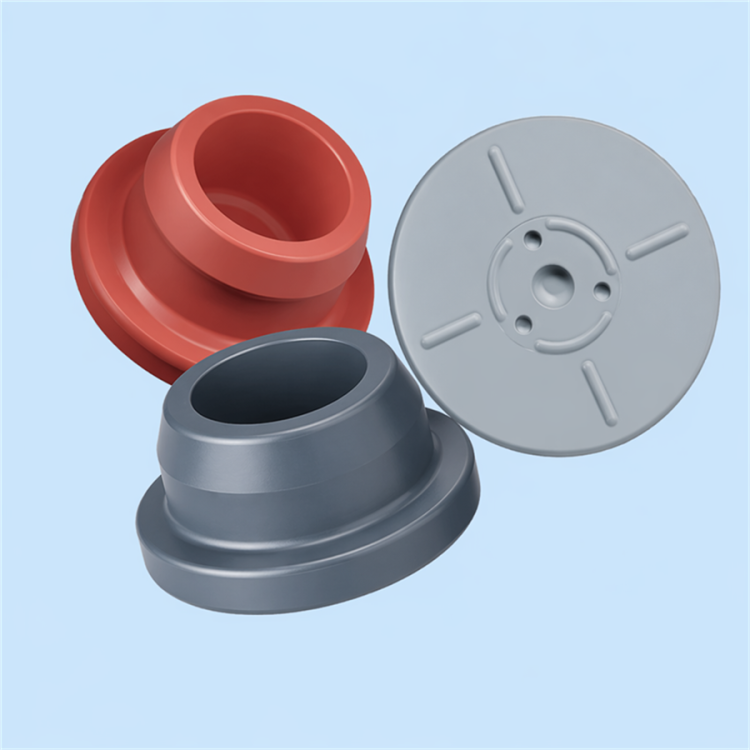
2. Comparing Suppliers: 5 Factors Beyond the Price Quote
The cheapest per-unit stopper is almost never the cheapest choice. Here's what else to compare when you're evaluating factory direct suppliers for a lyophilization program.
Factor 1 — Technical support during development. SHIMEN assigns a dedicated technical contact to every lyo program because we know these aren't catalog parts. Lyo stoppers aren't a catalog commodity. You'll have questions about moisture uptake, cycle compatibility, container closure integrity, and extractables. A supplier who can answer those questions directly — with real data, not marketing copy — saves you months. Ask: will you assign a technical contact? Do you provide stability support? Can you run custom studies if we need them?
Factor 2 — Regulatory documentation depth. DMF Type III coverage for the US, CEP or Ph. Eur. documentation for the EU, ISO 15378 certification for GMP. But don't stop at the certificates. Ask: is the DMF active and current? Is there open FDA correspondence? What's in the DMF scope — exactly which grades? A supplier with deep regulatory documentation is one who's invested in the regulated market long-term.
Factor 3 — Batch-to-batch consistency. SHIMEN tracks every production lot with SPC data. One great data sheet doesn't tell you much. What you care about is the range across lots — especially for moisture content and dimensional consistency, both of which directly affect lyo performance. Ask for SPC charts or multi-lot comparison data. A wholesale supplier who tracks every lot and can show you the trend is worth a premium over one who only gives you "typical" values.
Factor 4 — Minimum order quantities and lead times. Development orders are small. Commercial orders are large. A supplier whose MOQ is 10 million pieces is not a partner for early-stage work. Ask: what's the MOQ for development quantities? What's the lead time for a custom compound? What's the commercial lead time once validated? The right supplier supports you from 10,000-piece development runs to 100 million-piece commercial supply.
Factor 5 — Long-term supply reliability. A lyo stopper that works great but can't be consistently supplied at commercial volume is a dead end. Ask about manufacturing capacity, raw material sourcing diversity, and business continuity plans. For a product that takes years to develop, supply chain resilience matters more than saving a fraction of a cent per unit.
The moisture barrier question. Arguably the most important single performance attribute for a lyo stopper is its lyophilized product closure moisture barrier requirement — how much moisture will pass through the stopper into the vial over shelf life. Moisture is what degrades freeze-dried cakes. Two suppliers can both say "bromobutyl" and have meaningfully different moisture performance because of differences in compound formulation, filler loading, and cure system. Always compare actual moisture sorption data, not just the polymer name.
Shijiazhuang No.4 Pharmaceutical Group Co., Ltd. supplies lyophilization stoppers to bulk buyers, contract manufacturing partners, and virtual biotechs with low-volume development needs — with the same technical and regulatory support at every scale.
✅ Bottom line: Compare technical support, regulatory depth, lot consistency, MOQ/lead time, and supply reliability — not just per-unit price. The cheapest stopper is rarely the lowest total cost.
FAQ
Q: Do you have a freeze dried vial stopper specification checklist I can download?
A: Yes — every supplier should be able to give you a spec sheet with all the critical parameters (moisture, dimensions, particulates, extractables, etc.). If a supplier can only give you a one-page marketing sheet with no numbers, that's a red flag. Request the full technical data package and compare item by item across candidates.
Q: What's the difference between a "lyo stopper" and a regular bromobutyl stopper?
A: Not all bromobutyl stoppers are lyo stoppers. A true lyo-grade stopper has a low-moisture compound formulation, tight dimensional tolerances (to prevent pop-out during lyo cycles and ensure consistent seating), validated compatibility with freeze-thaw cycling, and particulate performance suitable for visible inspection against a white cake. A generic bromobutyl stopper may work for liquid vials but fail on one or more of these dimensions for lyophilization.
Q: Should I buy ready-to-use (RTU) stoppers or wash them in-house?
A: It depends on your volume and capabilities. RTU stoppers — pre-washed, siliconized, sterilized, and packaged for direct line introduction — give more consistent particulate and moisture performance because the washing is done by the specialist under validated conditions. They cost more per unit. In-house washing gives you more control and lower per-unit cost, but you take on the validation and GMP burden. For most lyo programs, especially with biologics, RTU is usually the right call.
Q: How do I get a price quote and samples from a supplier?
A: Send them your full specification (use the checklist above), your approximate annual volume, your target market, and whether you need development or commercial quantities. A good supplier will respond with a quote, sample availability, and a data sheet within a few business days. SHIMEN offers free development samples and no-obligation price quotes for any lyo stopper grade, and we test every grade to a lyophilized product closure moisture barrier requirement protocol so you know exactly what you're getting.
Request a Lyo Stopper Quote and Free Samples
Sourcing stoppers for a lyophilized product and want to compare options? Shijiazhuang No.4 Pharmaceutical Group Co., Ltd. — a leading China manufacturer of bromobutyl lyophilization stoppers with 78 years of pharmaceutical experience — provides the full ten-point specification package, DMF Type III access, and free development samples. Send us your product type, vial size, target shelf life, and approximate volume, and we'll send a price quote, samples, and the complete technical data package.
Contact us today — no obligation, just straightforward technical support.
Published: October 2026 | By SHIMEN Pharmaceutical Packaging Team