
LQ-Box III FAQ: LED Curing for European Dental Laboratories, Universities and Research Teams
Dental laboratories need equipment that fits their materials and daily workload. Universities and research teams also need a curing process they can describe and repeat within a defined protocol.
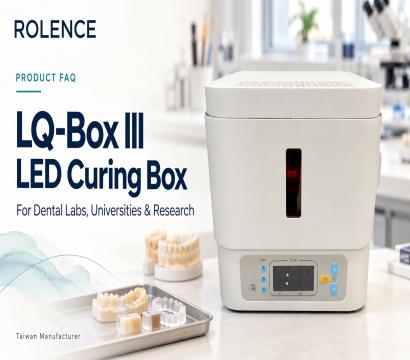
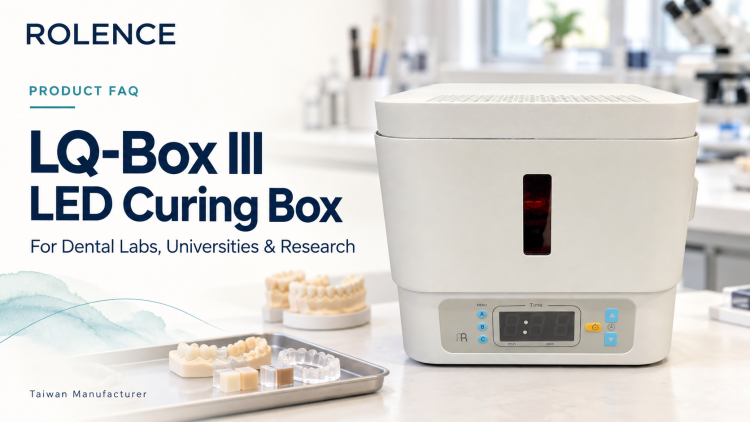
Rolence’s LQ-Box III is an LED curing box for light-curing dental resin applications and SLA/DLP post-curing workflows. With 42 LEDs, a rotating turntable and a spacious chamber, it offers a practical platform for evaluating laboratory and academic curing requirements.
1. Why work with Rolence for laboratory curing equipment?
Rolence is a Taiwan-based manufacturer whose product portfolio includes dental and laboratory curing equipment. Working with the manufacturer gives buyers a direct starting point for discussing the equipment configuration, application requirements and purchasing plan.
It also connects the discussion to a company that offers OEM and ODM cooperation.
2. What does the LQ-Box III offer a dental laboratory?
The LQ-Box III combines 42 LEDs with a rotating turntable, a digital control panel and an audible completion signal. Its published chamber dimensions are 200 × 200 × 85 mm.
These features give laboratories specific criteria for assessing their workpiece sizes, loading arrangements and daily curing tasks.
3. How does the rotating turntable support the curing process?
Rotation changes the workpiece’s orientation relative to the light sources during a cycle. The LQ-Box III also offers two turntable options for different applications.
For laboratories, this provides flexibility when planning workpiece placement. Select a loading arrangement that allows light to reach the surfaces requiring exposure.
4. Can the LQ-Box III fit into an SLA or DLP workflow?
Yes. Rolence presents the LQ-Box III for SLA and DLP post-curing applications.
Start with the resin manufacturer’s specified equipment, wavelength and exposure requirements, then confirm the matching LQ-Box III configuration and procedure. This establishes a defined process for the material you intend to use.
5. Why is it worth considering for universities and research groups?
The LQ-Box III provides a defined curing setup for dental resin projects and teaching activities.
Research teams can specify specimen dimensions, placement, exposure time and loading conditions in their protocols. Its controls and turntable make these process choices concrete, supporting clear instructions for students and laboratory users.
6. Can an institution discuss project-specific equipment requirements?
Yes. Rolence’s OEM and ODM offering provides a channel for discussing requirements beyond a standard purchase.
Share your requested configuration, quantities and evaluation criteria. The discussion can establish whether the brief fits the existing product or calls for a defined development project, with scope agreed before work begins.
7. What should laboratories consider when comparing purchase value?
Evaluate chamber capacity, workpiece access, controls, application fit and maintenance requirements alongside price.
The LQ-Box III’s chamber and turntable options are useful starting points for this comparison. For schools and universities, also consider how the unit will serve teaching sessions, shared facilities and planned research projects.
8. How do we begin a discussion with Rolence?
Send the resin name, its curing instructions, typical workpiece or specimen dimensions, expected batch sizes and your intended laboratory or research use.
Include the destination country and purchasing quantity. These details give Rolence a clear basis for discussing the product configuration and preparing a quotation.
Reviewing LED curing equipment for a dental laboratory, university or research facility? Contact Rolence to discuss the LQ-Box III and your application requirements.