
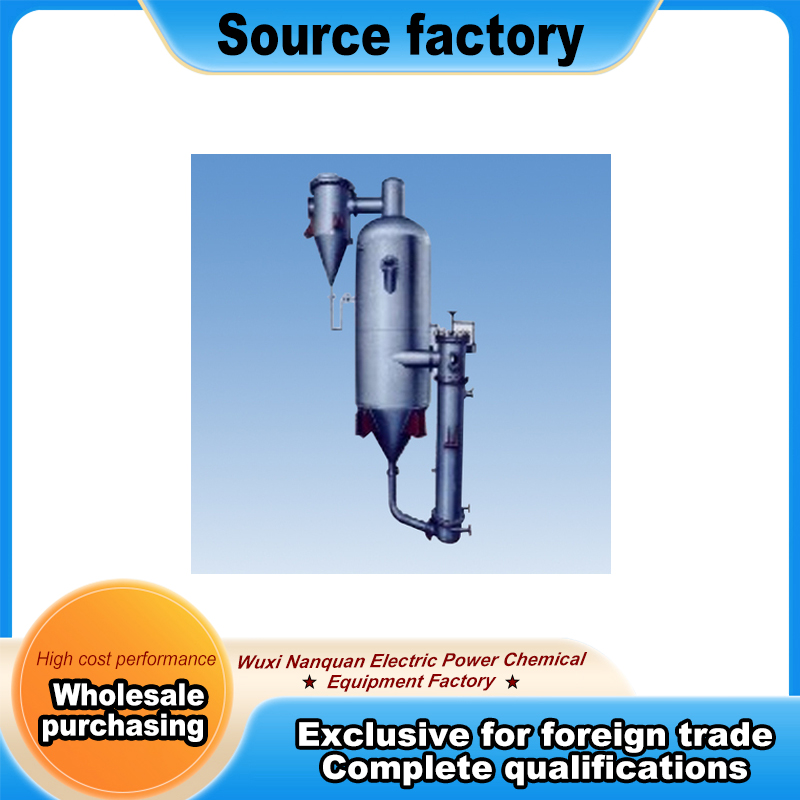
1. What Actually Limits Each Machine: Viscosity, Residence Time or Throughput?
Viscosity and residence time decide the choice; throughput only decides the model number. A natural-circulation unit depends on the liquid flowing up the heater tubes on its own buoyancy. Once the concentrate thickens, that circulation collapses, the tubes run dry at the top, and you get burn-on rather than evaporation.
The numbers that separate them:
| Parameter | LG rotating thin film | WZI external heating vacuum |
|---|---|---|
| Evaporation capacity (water) | 150–2,400 kg/h | 250–2,200 kg/h |
| Heating area | 1–12 m² | 3.0–22 m² |
| Evaporation intensity | 150–200 kg/m²·h | 85–100 kg/m²·h |
| Product contact time | 5–10 seconds | Minutes (large liquid inventory) |
| Workable viscosity | up to 100,000 cP | low viscosity, freely circulating |
| Operating vacuum | about 30 kPa absolute | about 10 kPa absolute (water boils near 46 ℃) |
| Configuration | single unit, continuous | single, double or triple effect |
| Materials | SUS304 / SUS316L | SUS304 / SUS316L |
Two consequences follow directly. First, the LG needs roughly half the heating area for the same water load, but costs more per square metre — so it wins on footprint, not on capital. Second, the LG's slotted rotor keeps renewing the film against the wall, which is why its capacity runs 40–69% above a fixed-gap blade machine on sticky feeds, and why it can take a feed that would stop a circulating evaporator dead.
Where the WZI is simply better: clear, low-viscosity liquor at volume. Water extracts at 1.05–1.15 SG, fruit juice, milk, fermentation broth — material that circulates freely, does not scale, and needs 1,000 kg/h or more of water removed. At that duty a triple-effect WZI is the cheapest machine per tonne of water evaporated, and its 22 m² heater gives the turndown to run at half load without losing film stability.
Both series come off the same pressure-vessel line at NANQUAN, so this is a process decision rather than a supplier switch — the quotation is comparable line for line.
✅ Bottom line: Above about 1,000 cP or with fine solids, only the rotating film design holds; below that, circulation wins on cost.
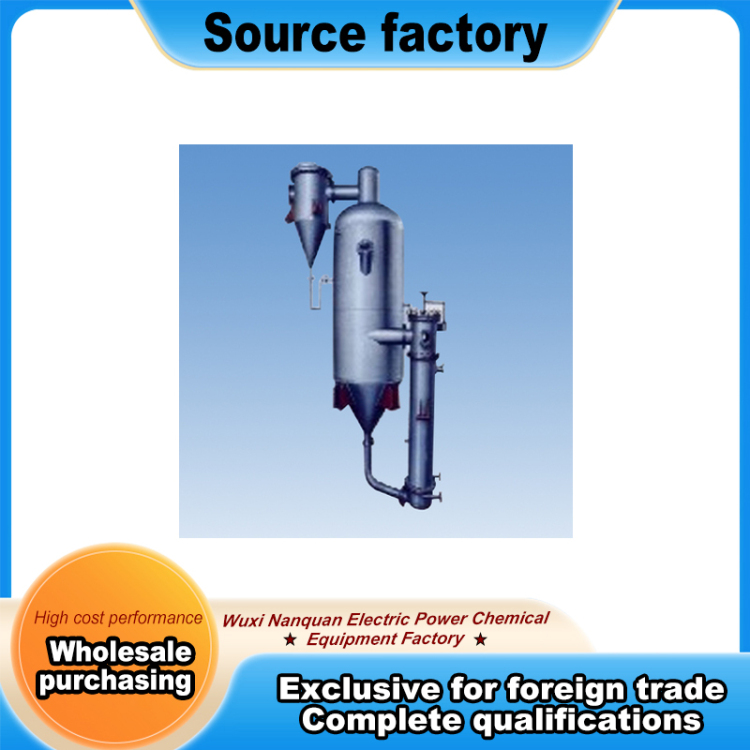
2. Which Configuration Costs Less to Run at Your Capacity?
Steam economy decides it for water, and solvent value decides it for ethanol — they rarely point the same way. A single-effect evaporator consumes about 1.0–1.1 kg of steam per kg of water removed. Double effect brings that to roughly 0.55, triple effect to 0.38, because each effect reuses the vapour from the one before it.
Run the arithmetic on a realistic duty: 1,000 kg/h of water removal, 6,000 operating hours a year, steam at USD 25/t.
- Single effect: 6,000 t water × 1.05 = 6,300 t steam → about USD 158,000 a year
- Triple effect: 6,000 t × 0.38 = 2,280 t steam → about USD 57,000 a year
The USD 100,000 annual gap typically pays back the extra cost of a multi-effect set in under two years on continuous duty. That is the case for the WZI Type External Heating Vacuum Evaporator on aqueous extract — and the reason most new botanical plants above 1,000 kg/h specify at least double effect.
Ethanol breaks that logic. Multi-effect only works because water vapour from one effect can heat the next; with 60–75% ethanol you cannot cascade the vapour that way, so the recovery stage is single-effect by design and the economics move to how much solvent you get back. This is where the LG Type Efficient Rotating Thin Film Evaporator earns its price: a five-to-ten-second contact time and an external condenser mean less hold-up, less reflux, and less thermal damage to the fraction you are trying to keep. At USD 700–900/t for food-grade ethanol, a two-point improvement in recovery on 500 kg/h of solvent is worth more per year than the entire steam saving above.
Practical selection, duty by duty:
| Duty | Specify | Why |
|---|---|---|
| Water extract, 1.05–1.15 SG, >1,000 kg/h | WZI, double or triple effect | Lowest steam per kg; free circulation |
| 60–75% ethanol recovery | LG, single effect + condenser | Short residence time, no vapour cascade possible |
| Final concentration to paste, 85%+ solids | LG | Circulation stops; film does not |
| Heat-sensitive API, degradation above 60 ℃ | LG | 5–10 s at temperature instead of minutes |
| High-solids slurry with fine crystals | LG with slotted rotor, pre-filtered | Wears blades on hard particles above ~0.5 mm |
Whichever route you take, the feed arriving from upstream matters as much as the evaporator. Extract leaving an Alcohol Precipitation Tank still carries floc unless the Liquid Separator stage did its job, and both evaporator types trade heating area for cleaning cycles on a hazy feed. Feed a clean liquor and the difference between a good and a poor installation is mostly vacuum discipline.
✅ Bottom line: Use multi-effect circulation for bulk water and single-effect rotating film for solvent and high-solids duty.
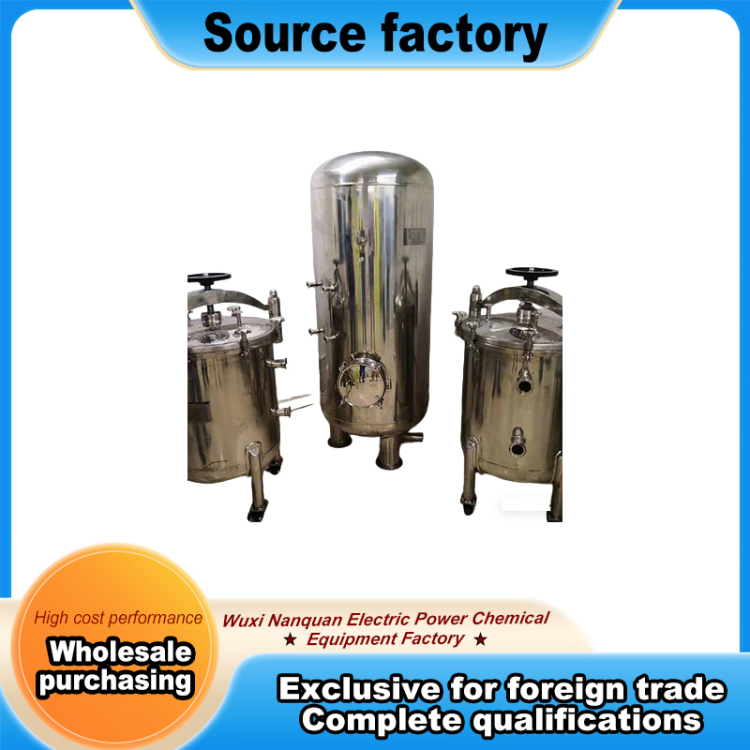
FAQ
Q: Can a WZI run as a triple effect on ethanol extract? A: No. Multi-effect depends on cascading water vapour, which an ethanol-rich vapour cannot do safely or usefully. Alcohol duty stays single-effect with a dedicated condenser, explosion-proof electrics and solvent recovery; the steam penalty is offset by recovered solvent value.
Q: How do I estimate the heating area I need? A: Divide the required evaporation rate by the evaporation intensity: 1,000 kg/h ÷ 200 kg/m²·h gives 5 m² for an LG, or ÷ 90 gives about 11 m² for a WZI. Add 20–30% margin for fouling and turndown, then confirm the vacuum your cooling water can actually hold.
Q: Do you build these to overseas standards, and can we customise? A: Yes. NANQUAN builds to ASME and EN practice with Class I and Class II pressure vessel qualifications, and takes OEM/ODM orders on custom configurations — materials, effect count, condenser type and control scope. Wuxi Nanquan Electric Power and Chemical Equipment Factory has supplied this equipment line from Wuxi since 1998.
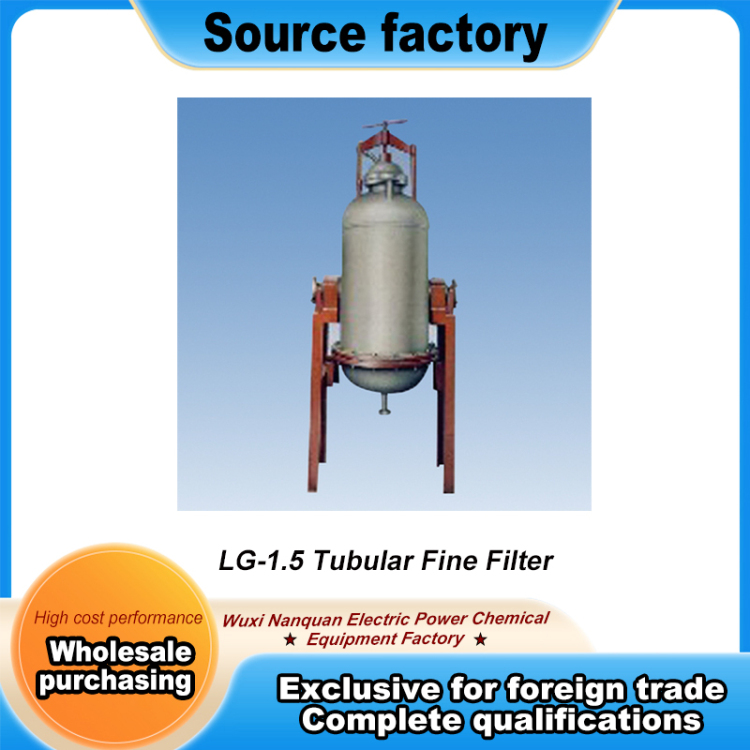
CTA: Send the Boiling Curve, Get a Sizing Sheet
Give the NANQUAN team your feed viscosity at operating temperature, solids content, target final concentration and hourly water or solvent load — and you get a model recommendation with heating area, steam consumption and expected recovery, plus a factory-direct price for single units or bulk lines. Custom skids combining Extraction Equipment, precipitation and evaporation are quoted as one package so the interfaces are one supplier's problem, not yours.