
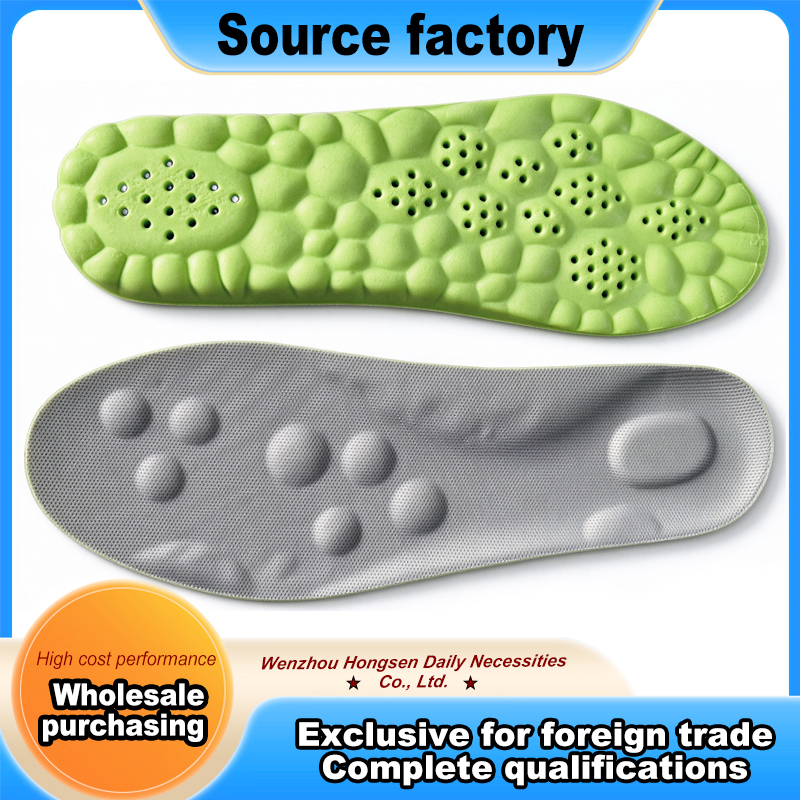
Athletes rarely complain about a material. They complain about a heel that rolls, a forefoot that flattens at month four, or an arch that feels like a stone. Those three complaints map onto three different constructions, and a fourth exists purely to hit a price point. HONGSEN builds all four in Wenzhou under one roof, which makes the trade-offs easier to see side by side. Here is what each build actually does, where it breaks, and how to split a first order.
1. What does each construction actually do under heel strike — and where does it fail?
Each build solves a different problem. Latex TPU controls rearfoot motion, Sports EVA distributes load by zone, Blue Green TPR absorbs peak impact at the lowest cost, and Arch Support Wave lifts an arch that is collapsing inward.
| Build | Core stack | Hardness / density | Best for | Typical failure |
|---|---|---|---|---|
| Latex TPU | Soft latex body + moulded TPU heel cup | TPU 95A–55D; latex 75–110 kg/m³ | Court sports, trail, heavier athletes | TPU above 60D creates a pressure ridge at the calcaneal edge; latex-to-TPU bond shears after 4,000–6,000 flex cycles |
| Sports EVA | Two- or four-density moulded EVA, colour-zoned | 0.18–0.30 g/cm³; 40–55 Shore C | Running, training, gym | Forefoot permanent set under 80 kg+ when density drops below 0.20 g/cm³ |
| Blue Green TPR | SBS/SEBS TPR heel pad under foam body | 50–70 Shore A; rebound 60–80% | Entry-price running, walking, school sport | Softens above 75–80 ℃, so a summer container or a hot car display changes the feel; swells on oil contact |
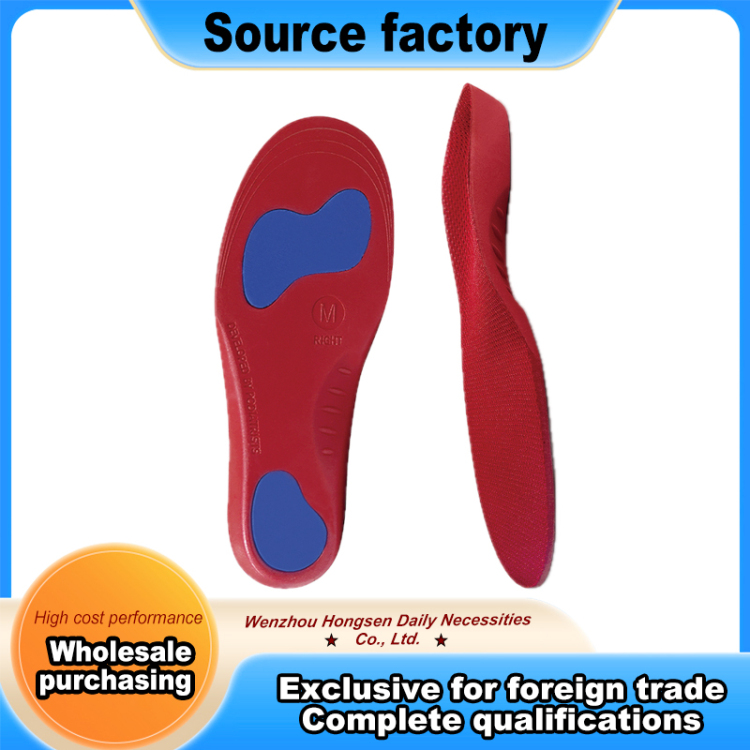
| Arch Support Wave | Wave-profile arch shelf moulded into the base | Wave height 5–12 mm; base 55–75 Shore C | Flat feet, low arch, overpronation | Wrong wave height for the arch type — a 12 mm wave reads as a stone under a neutral foot |
The Latex TPU build is the only one that solves rearfoot motion properly, because the TPU heel cup resists inversion while the latex body still compresses. Two specs decide whether it works: keep the cup at 95A–55D (harder than 60D and the cup edge becomes a pressure point, softer than 90A and it flexes away from the calcaneus) and demand a peel test after 5,000 flex cycles. That bond line is where cheap versions fail, and it fails at the heel edge where the wearer feels it most.
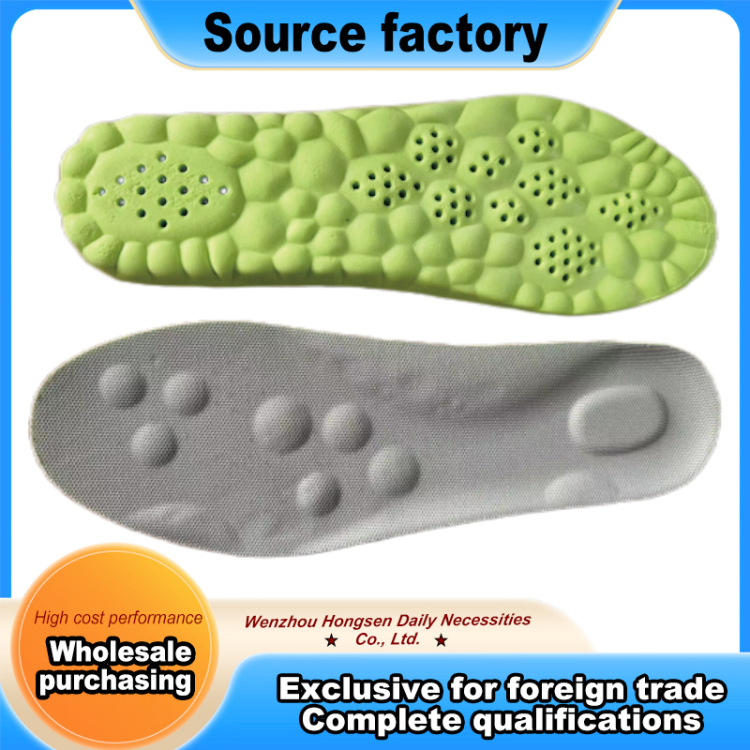
The Sports EVA build earns its place through zoning. Colour-coding is not decoration — each colour is a different density, and the useful band is 0.20–0.30 g/cm³ with the forefoot one step softer than the heel. Below 0.20 the forefoot takes a permanent set under a heavier runner and the insole goes flat before the outsole does. Ask for the density of each colour in writing; a "four-colour" insole with one density throughout is a cosmetic product.
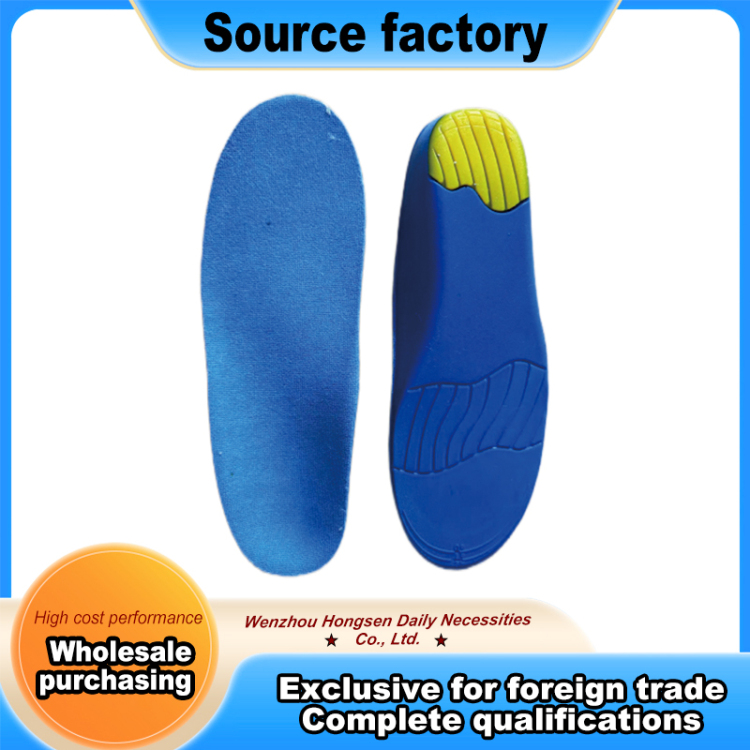
The Blue Green TPR build is the price-point builder. TPR rebound of 60–80% and a 50–70 Shore A heel pad absorb heel strike credibly for a fraction of a TPU cup, and the material moulds easily into a distinctive blue-green colourway that reads as "technical" on shelf. Its weakness is thermal: TPR softens above 75–80 °C and swells on oil contact, so it is a poor choice for goods that sit in a Gulf container in July. Specify a 72-hour heat-ageing check at 70 °C if your market ships through hot corridors.
The Arch Support Wave build is the one buyers most often get wrong. The wave shelf works by lifting the medial arch gradually instead of propping it, which is why it suits flat and low arches and feels intrusive under a neutral foot. Match wave height to the target arch: 5–7 mm for a low arch, 8–10 mm for flat, and skip the build entirely for neutral-foot consumers. A wave 3 mm too tall converts a comfort product into a return.
✅ Bottom line: Choose Latex TPU for rearfoot control, Sports EVA for zoning, Blue Green TPR for price, Arch Support Wave for flat arches — never the reverse.
2. Which build goes in the first container — and how should the range be split?
Split the range instead of picking one winner. A single-construction order caps your price ladder at one rung, and sports insole buyers shop across at least three rungs whether you stock them or not.
A workable split for a 10,000-pair first order:
- 50% Sports EVA — the volume driver. Multi-density EVA covers running, training and gym at a mid price point, and it is the model most likely to be reordered.
- 25% Latex TPU — the margin and credibility model. It justifies the top of your range and gives your sales team something to demonstrate.
- 20% Blue Green TPR — the entry price point that keeps you on the shelf next to the value brands. Do not exceed this share; TPR's thermal limits make it a poor flagship.
- 5% Arch Support Wave — a specialist SKU, not a volume line. Stock two wave heights, not five, and label the arch type on the pack.
Then check the ladder against retail: a TPR build lands at the entry rung, EVA at the middle, Latex TPU at the top. If two builds land at the same shelf price, you have over-specified the cheaper one or under-specified the dearer one — re-cut the spec rather than discounting.
Three procurement points decide whether the split survives production. First, ask whether the minimum order can be mixed across models and sizes; 500 pairs per model is a different proposition from 500 per order. Second, confirm mould ownership and whether tooling for a custom outline is amortised or charged up front. Third, ask for the density of every layer, not the headline material — "EVA" alone says nothing about whether the forefoot survives a season.
HONGSEN supplies all four builds from the same facility, so a mixed first order can be packed by model and by destination without a consolidation step, and each build can carry its own retail packaging. Wenzhou Hongsen Daily Necessities Co., Ltd. has been moulding insoles since 1996 and runs OEM and ODM programs for buyers in the US, Europe and Southeast Asia, with custom colourways, topcover fabrics and packaging handled in-house.
✅ Bottom line: Lead with Sports EVA volume, protect margin with Latex TPU, and cap Blue Green TPR at a fifth of the order.
FAQ
Q: For a USD 25 retail running insole, is a TPU heel cup or a TPR heel pad the better build? A: TPU at that price point, provided the cup stays at 95A–55D and the bond passes a 5,000-cycle peel test. TPR is the right call below roughly USD 15 retail, where the cost gap buys more perceived value elsewhere in the product.
Q: Is a four-colour Sports EVA insole really four different densities? A: Only if the supplier states the density of each colour. Ask for the number per zone; if one figure comes back for the whole insole, the colour is cosmetic and the forefoot will flatten at the same rate as a single-density build.
Q: What wave height should an Arch Support Wave insole use for flat feet? A: 8–10 mm for a flat arch and 5–7 mm for a low arch, with the shelf starting at the medial midfoot rather than the heel. Test both heights on ten wearers before you commit — 2 mm is enough to change a comfort product into a return.
CTA: Build the range before you build the container
Send your target retail price points, sport categories and annual volume, and HONGSEN will return a recommended construction split, layer-by-layer density specifications for each build, and a sample set covering Latex TPU, Sports EVA, Blue Green TPR and Arch Support Wave in your chosen colourways. Custom OEM and ODM programs start at 500 pairs per model, with tooling quoted up front.