
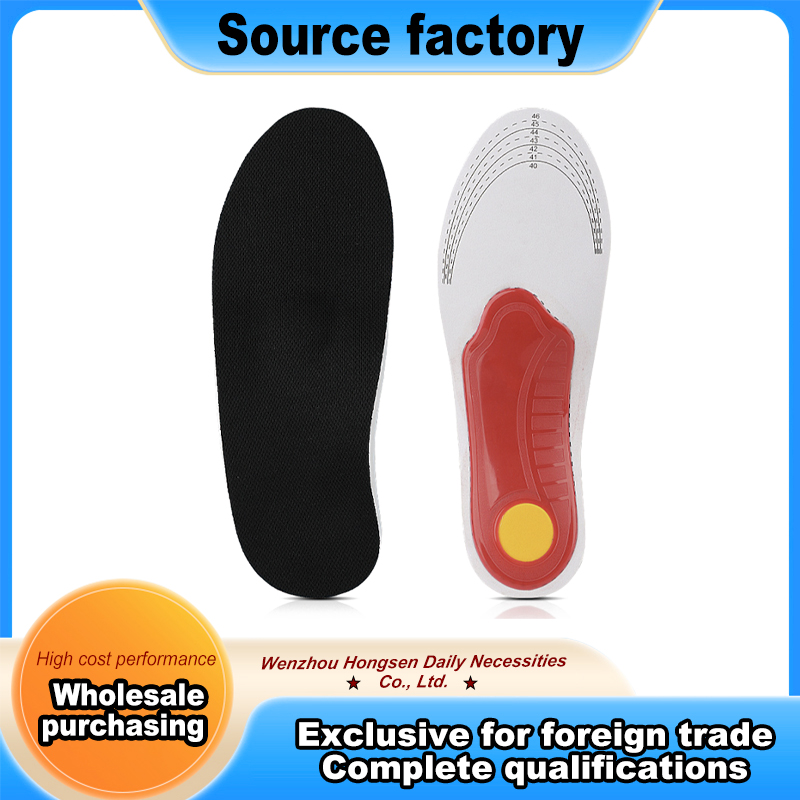
Buyers comparing quotes usually see a 3–5x unit price gap between latex and PU and read it as a materials markup. It is a service-life difference. On a work-boot, uniform or retail counter program, the cheap insole does not save money; it converts a reorder into a complaint. HONGSEN has been moulding insoles in Wenzhou since 1996, and the three questions export buyers still ask are unchanged: what density, what thickness, and how many sizes must I carry. Here are the numbers behind each one.
1. How much does Latex Foam density actually change a Pressure Relief claim?
Density is what keeps a pressure relief claim true after month three. A Pressure Relief claim under the metatarsal heads or the heel is really a claim about thickness that survives repeated loading, and compression set is what breaks it.
Published insole compression data is consistent across sources. Open-cell PU at 30–45 kg/m³ loses 40–60% of its original thickness within 1,000–2,000 cycles and 60–80% by 3,000–5,000. Closed-cell PU and EVA at 55–90 kg/m³ lose 20–35% in that same first window. Latex Foam at 75–110 kg/m³ loses 8–18%, and 18–30% at the far end of the range.
Translate it into a 4 mm forefoot. The PU insole sits at 1.6–2.4 mm inside six months of daily wear — the wearer is effectively standing on the substrate. The latex insole is still above 3.3 mm. Only one of those two can hold a pressure relief claim at month nine, and it is not the one that won the quote.
| What to specify | Target range | Why it matters at the QC bench |
|---|---|---|
| Density | 75–110 kg/m³ (±5%) | Below 70, cell walls collapse early under an 80 kg wearer |
| Compression set | ≤10% at 50% compression, 22 h / 23 ℃ | Best single predictor of thickness loss in service |
| Thickness tolerance | ±0.3 mm full length | A 0.5 mm thin heel cup becomes a pressure point, not a cushion |
| Ball rebound | ≥40% | Below 35% the insole feels dead within weeks |
| Lamination peel | ≥3.0 N/cm after 60 ℃ / 72 h | Water-based adhesive shears in a hot container |
Two more specs decide whether the product actually feels dry. Breathable topcovers are not a fabric adjective — request moisture vapour transmission rate on the finished laminate, and confirm the perforation runs through the foam, not only through the cloth. A perforated cover over closed-cell foam traps water in the foam and smells worse than no perforation, because the moisture has nowhere to evaporate. Separately, insist on the hot-container peel check: an adhesive that passes at 20 °C can delaminate after three weeks in a summer container, and that failure arrives as a return, not a claim.
For buyers running a private label line, HONGSEN tests density and compression set per production batch rather than per order, which is why OEM buyers can hold a ±0.3 mm tolerance across shipments six months apart.
✅ Bottom line: Specify latex density and compression set before thickness; a 4 mm latex insole outlasts a 6 mm PU one on any daily-wear program.
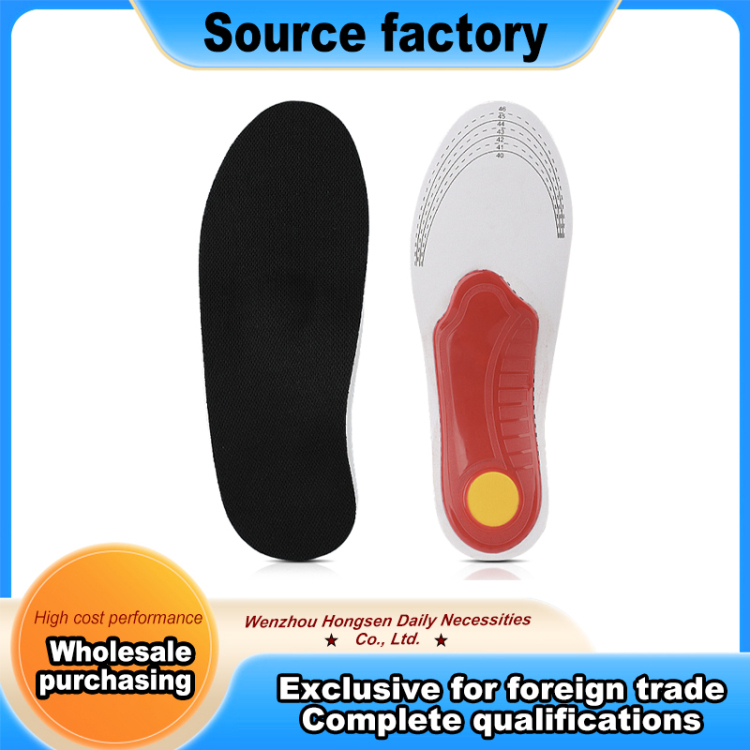
2. Does Trim to Fit really cut SKU cost, or just move it to returns?
It cuts SKU count by roughly 70% and moves a small, predictable risk to the end user — provided the trim lines and cutting allowance are engineered rather than printed on as an afterthought.
Fixed sizing across EU 36–46 means eleven cutting files, eleven labels and eleven carton markings — twenty-two SKUs once you add two colours. A Trim to Fit program covering the same range in two groups (36–41 and 42–46) needs two files, two labels and four SKUs. For a retailer holding 1.2 m of shelf, that is the difference between carrying a full range and carrying three sizes of it.
The cost you take on is cutting error, and it is predictable. Three controls remove most of it:
- Two-millimetre toe allowance. Print the trim line 2 mm inside the true outline. Over-cutting at the toe is the number one end-user complaint; under-cutting by 2 mm is invisible once the insole is in the shoe.
- Heel-aligned template. Put a heel-centre notch and an "align heel first" mark on the underside, not the top. Users trace the factory footbed from the heel, and heel width is what stops the insole creeping forward mid-shift.
- One card, three steps. A 90 × 50 mm instruction card costs roughly USD 0.006 at 10,000 units and removes the "I cut it wrong" support ticket entirely.
One limit deserves stating plainly: trimming changes length, not width or volume. In a shallow court shoe or a low-volume loafer, a full-length Trim to Fit blank will crowd the upper however carefully it is cut. Keep a three-quarter or fixed-size option for those accounts instead of forcing the format.
HONGSEN supplies trim-to-fit programs with buyer-branded cutting cards and carton markings, and allows models and sizes to be mixed inside a single minimum run — which matters more than unit price when you are testing a range rather than committing to one shape. Wenzhou Hongsen Daily Necessities Co., Ltd. produces both formats in the same facility, so a fixed-size and a trim-to-fit version of the same outline can be cut from one master file.
✅ Bottom line: Trim to fit wins on shelf economics above six sizes; keep fixed sizes only for low-volume shoe accounts.
FAQ
Q: What latex density and thickness should I specify for a work-boot insole? A: 85–100 kg/m³ with ≤10% compression set, 5–6 mm at the heel tapering to 3.5–4 mm at the forefoot, plus a 1.5–2 mm heel cup. Anything thinner at the forefoot will bottom out under a 90 kg wearer within a year, whatever the density.
Q: What is a realistic minimum order for a private label Trim to Fit program? A: Most factories quote 500–1,000 pairs per model, and a good OEM supplier will let you mix sizes and two colours inside that number. Ask whether "mixed" covers models as well as sizes before you approve the sample.
Q: How do I verify a Breathable topcover instead of trusting the spec sheet? A: Request MVTR on the finished laminate, not the fabric roll, plus a 24-hour wear trial on ten pairs in a warm room. If the foam underneath is closed-cell, MVTR can read well and the foot will still feel wet. HONGSEN ships both the laminate data and a cut cross-section with every sample set.
CTA: Get the specification sheet before you get the price
Send your target shoe, wear scenario and annual volume, and HONGSEN will return a density and thickness recommendation for your Latex Foam program, a trim-to-fit versus fixed-size SKU comparison for your size range, and a sample pair with the cross-section photographed. Custom OEM and ODM runs start at 500 pairs per model, with buyer-branded packaging, cutting cards and carton marking handled in-house.