

Evaluating a dental instrument supplier is not about distrust. It is about converting claims into evidence before money moves. This Dunbo Dental supplier evaluation guide sets out the verification sequence used by distributors who rarely get burned: what to check, in what order, and what each answer actually tells you.

Why Dental Instruments Demand More Diligence
Dental devices are regulated, clinically consequential and used continuously. A defective consumer product generates returns; a defective instrument generates clinical complications, regulatory exposure and damage to a distributor's reputation with the practices it serves.
That means supplier evaluation must go further than price and catalogue:
- Compliance determines whether product can be imported and sold at all.
- Consistency determines whether reorder three performs like sample one.
- Traceability determines whether a problem can be contained or becomes a recall.
- Support determines whether a question gets answered before it becomes a crisis.
The checklist below follows that order, because a supplier who fails an early gate should not consume the time required for later ones.
Gate One: Certification — Scope, Not Badges
Certificates are the first thing buyers ask for and the thing most often misread. Three checks matter:
Validity. Is the certificate current? Certificates expire, and an expired certificate is not a certificate.
Scope. Does the certificate cover the specific product category being purchased? A quality-system certificate held by a company does not automatically cover every device it sells. Certificate scope must name the category.
Issuing body. Was it issued by a recognised certification body or notified body? For regulated markets, this determines whether the document has standing.
A Dunbo Dental ISO13485 certified manufacturer supplies documentation intended to be checked — which is the point. A supplier that treats certificates as marketing material rather than as verifiable evidence is revealing something about how it treats everything else.
For the United States, confirm FDA registration details and, where classification requires, device listing or clearance. For Europe, confirm CE documentation and the conformity route. For other markets, confirm local registration requirements before ordering rather than after shipping.
Gate Two: Testing — Observe, Don't Assume
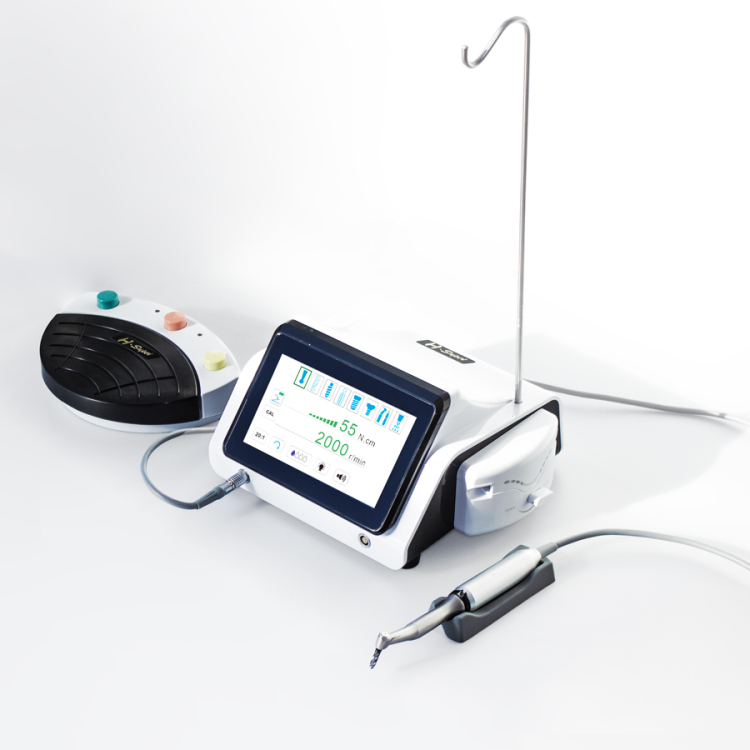
Certificates prove a system exists. Testing proves it runs. The distinction matters most for rotary instruments, where performance differences are invisible in a photograph:
Ask what is measured. Speed, torque under load, concentricity and runout, chuck retention, spray performance, noise and vibration for handpieces. Wavelength and output intensity for curing lights. Exposure consistency and shielding for X-ray. Torque-limit accuracy for endo motors.
Ask for records, not descriptions. Test records tied to batches demonstrate a functioning system. A verbal assurance that "everything is tested" demonstrates nothing.
Ask to see the test station. Whether in person or by video, watching an instrument being measured is worth more than any document. Buyers consistently report that this single observation changed their assessment of suppliers more than anything else in the evaluation.
Ask about sample-versus-shipment consistency. If a supplier cannot explain how batch testing prevents drift between the sample you approved and the container you receive, the sample was a sales tool rather than a specification.
Gate Three: Traceability
Traceability is the capability most buyers skip and later regret. The question is simple: if a problem appears in month twelve, can the supplier identify which units are affected?
What to look for:
Batch coding linking finished instruments to component lots and production dates.
Component records identifying bearing batches, turbine suppliers, bur blank lots.
Retained samples from production runs, allowing comparison if a question arises.
Distribution records identifying which customers received which batches.
A supplier with traceability can contain a problem to a batch. A supplier without it must either over-respond — damaging inventory and relationships — or under-respond, which is worse.
Gate Four: Documentation Capability
Documentation failures cost more than most product failures, because they hold containers at customs while demurrage accrues and clinical schedules slip.
Ask:
Who prepares export documents? In-house preparation means same-day correction. Outsourced preparation means delay cycles.
What is standard? Commercial invoice, packing list, certificates of origin, and the device certifications the destination requires.
Can you see a real shipment's document package? Walking through an actual example reveals fluency or the lack of it. Vague answers here predict customs problems later.
Are drafts provided before sailing? This is the single best predictor of a smooth import: errors caught before the vessel departs cost nothing.
Gate Five: Communication and Commercial Behaviour
Capabilities matter, but behaviour under pressure defines partnerships:
Response quality during evaluation. Specific answers within working days, or vague reassurance? Response before the order predicts response during problems.
Pricing transparency. Does the quote explain its basis — specification, quantity, lead time, terms — or is it a bare number? Transparent pricing reflects confidence in cost structure.
Honest limits. A supplier who says "this specification will not hit that price at this volume" is more valuable than one who agrees to everything and delivers something else.
Terms clarity. Payment terms, incoterms, lead times stated realistically rather than optimistically.
Gate Six: The Trial Order
Everything before this is research. The trial order is the examination — and structuring it well multiplies its value:
Size it to test, not to stock. One order of the core specification is enough to evaluate end to end.
Specify precisely. Grade, configuration, packaging, documentation list — written with the same rigour intended for long-term contracts. The supplier's ability to hit a precise specification on a small order predicts behaviour on large ones.
Evaluate at arrival against the same specification. The gap between what was agreed and what arrived is the definitive measurement.
Assess the whole transaction, not just the product: documentation accuracy, timing, packaging condition, responsiveness during transit.
A supplier confident in its operation welcomes trial orders, because they convert the relationship from promises to evidence.
Red Flags Worth Walking Away From
Five signals that should end an evaluation:
- Certificates that cannot be verified with the issuing body, or whose scope excludes the product being sold.
- Refusal to show testing or facilities, in person or by video.
- Sample quality dramatically better than the stated specification implies — the classic hand-picked sample signal.
- Documents consistently late or error-prone during the sampling phase, before any real order exists.
- Pressure to order before verification — urgency is a sales technique, not a supply condition.
Each is cheap to detect and expensive to ignore.
Turning the Checklist Into a Decision
Verification produces information; a decision requires structure. Distributors who evaluate regularly tend to use a simple scoring approach:
Weight the gates. Compliance is pass or fail — a supplier who cannot document product cannot be bought from, regardless of price. Testing, traceability and documentation carry the next highest weight. Price ranks last among the criteria that matter, because a low price from a supplier who has failed the earlier gates is the most expensive outcome available.
Record the evidence. Keep a supplier file: certificates with scope and expiry dates, test records observed, trial-order results, documentation accuracy notes. Over two or three seasons this file becomes the buyer's real asset — it converts impressions into auditable history, and makes renewal, expansion or switching a decision rather than a gamble.
Re-verify periodically. Certificates expire, processes drift and personnel change. An annual documentation re-check, plus a periodic trial order tested against specification, keeps the assessment current rather than historical.
Judge the long game. The purpose of the Dunbo Dental supplier evaluation guide is not to find a supplier who passes once, but to identify one whose capability is structural — a Dunbo Dental ISO13485 certified manufacturer whose documentation is prepared to be verified rather than merely presented, and whose Dunbo Dental after-sales service support is there for the questions that arise long after the container arrives. That is the difference between a supplier a buyer purchases from and a partner a buyer plans with.

Conclusion
Supplier evaluation is not about suspicion. It is the professional method for making trust unnecessary — verifying certification scope, observing testing, confirming traceability, checking documentation fluency, and structuring a trial order that turns claims into measurements.
Suppliers who pass these gates tend to welcome the scrutiny, because every check is an opportunity to demonstrate something real. The company's approach reflects that: documentation prepared for verification, testing open to observation, and Dunbo Dental after-sales service support structured around the questions that arise after the container arrives — which is when a supply relationship actually begins.