
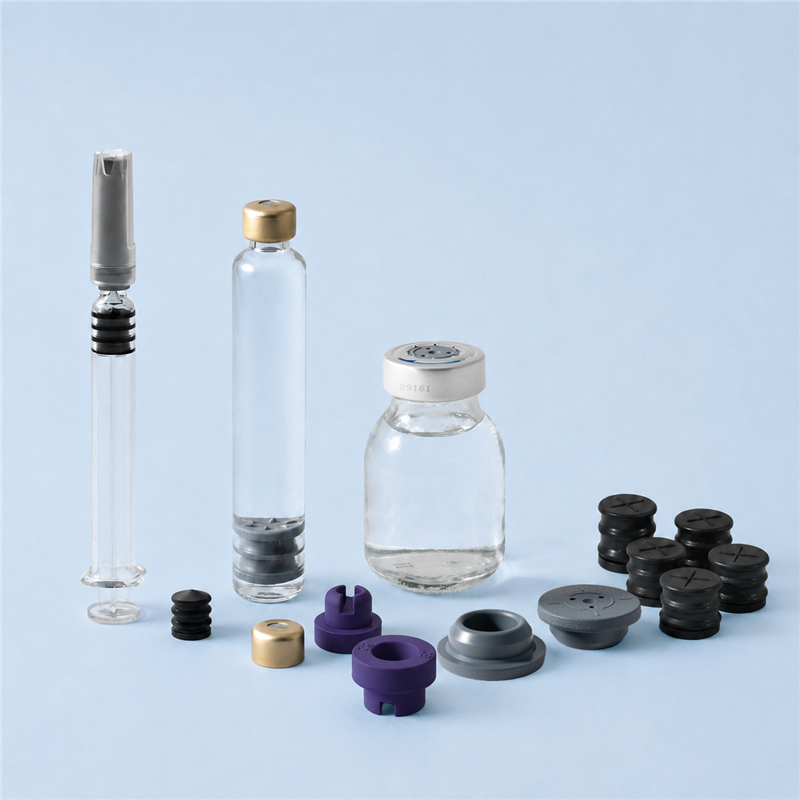
Coring — the punching out of a small rubber fragment during needle entry — is the most common stopper-related complaint in hospital pharmacy. Every time a nurse or pharmacist spikes an IV bottle, the needle or administration set cannula passes through the stopper. If the compound is wrong, the access device is blunt, or technique is poor, a fragment ends up in the solution. Antibiotic infusion bottle rubber stopper coring is preventable, and most of the fixes cost nothing once you know where to look.
This guide covers why LVP stoppers core more often than vial stoppers, what to specify, and how to verify improvement.
1. Why do IV bottle stoppers have more coring problems than vial stoppers?
- The mechanism is the same everywhere, but three things make large-volume parenterals worse.
- Repeated access with different devices. An infusion bottle may be entered multiple times during a shift — once for diluent, once or more for additives, once for the administration set spike. Each entry is another chance to generate a fragment. And each type of access device — needle, plastic cannula, administration set spike — behaves differently against the rubber. Blunt plastic spikes, in particular, tend to push material rather than cut it, which is where most visible fragments originate. IV bottle stopper fragmentation prevention has to be validated against the actual devices used in your target hospitals, not against a lab needle.
- Larger stopper, thicker target zone. IV bottle stoppers are bigger and often thicker than vial stoppers, so there is simply more rubber in the puncture path. The target zone — where entry is intended — is also wider, which means off-center entry is more common and more material is in play. A well-designed target dimple or thinner central membrane helps, but only if hospitals actually enter in the right place.
- Reconstitution context with powder antibiotics. Many antibiotic LVP products ship as powder requiring reconstitution. The stopper gets punctured at least twice: once to add diluent, once to withdraw or attach the set. Each puncture is independent, and a fragment created at either step ends up in the line. For pediatric or ICU use, where particle risk tolerance is effectively zero, this matters more than almost any other stopper attribute.
- Two properties drive everything else: hardness (Shore A) and tear resistance. Too soft, and the needle drags material rather than parting it cleanly. Too hard, and insertion force rises, which encourages off-angle entry and slippage. The ideal window is narrower than most buyers realize, and it interacts with the closure geometry — the target zone thickness and any dimple or guide feature.
Bottom line
✅ Coring is a compound-and-geometry problem, not a quality-of-manufacturing problem. Specify hardness and tear resistance explicitly, validate with the actual access devices used in your target markets, and don't assume a stopper that passed one test will perform the same under real clinical use.
2. Six things to put in your specification — and how to verify each
This is the working list procurement and QA teams can actually use.
1. Define the coring test and acceptance criterion up front. USP <381> covers elastomeric closures for injections and includes fragment testing; the ISO equivalent is ISO 8871-5 (functionality testing). Don't just write "meets pharmacopoeia." Specify the number of punctures, the needle or spike type and gauge, and the maximum fragments acceptable per unit. Typical acceptance for a well-formulated LVP stopper is zero visible fragments after a defined number of punctures. Writing antibiotic infusion bottle rubber stopper coring criteria into your purchase specification is what makes every subsequent check enforceable — it gives both your QA team and the supplier the same definition of acceptable, rather than arguing about it after a complaint arrives.
2. Test with the actual administration sets used in your market. This is the single most valuable thing you can add to your qualification. If your target hospitals use a specific IV spike or cannula, test punctures with it. Large volume parenteral rubber closure quality is meaningless in the abstract — it is specific to the combination of closure and access device. A great stopper against the wrong device will still produce complaints.
3. Hold the hardness window tight, not wide. Ask for Shore A hardness measured per ISO 7619-1, then set a narrow range — typically 5–7 Shore A points wide, centered on the value that balances cutting and insertion force. A supplier delivering anywhere inside a 10-point band is technically in spec, but the lots at the soft end will core measurably more than the ones in the middle. SHIMEN centers every LVP grade within a controlled band and reports actual lot hardness, not just pass/fail against wide limits.
4. Confirm the puncture zone design and inspect it per lot. If your stopper has a target dimple or thinner central membrane, confirm the drawings match the parts you receive — and add a dimensional check for that feature to incoming inspection. Small tooling wear changes this geometry invisibly, and coring performance drifts long before any other attribute fails. SHIMEN tracks target-zone dimensions on every production tool and replaces it before drift becomes measurable — that is one of the quietest but most important differences between a controlled process and a pass-fail one.
5. Add post-puncture particulate testing. Coring isn't the only particle source. Ask for sub-visible particulate counts per USP <788>, measured after simulated puncture, not only on untouched units. This catches both coring debris and loose surface particles from washing and handling. SHIMEN runs post-puncture particulate counts as standard release testing for LVP grades, because we believe that is what the clinician actually sees at the point of use.
6. Review lot-to-lot trend data, not just certificates. Ask for coring and particulate performance across several recent lots and check for drift. A supplier running statistical process control can show you the chart; one who can't probably doesn't know their own process. For buyers doing multi-source qualification, comparing large volume parenteral rubber closure quality between candidates should always use the same test protocol on the same spike — otherwise you are not comparing the stoppers, you are comparing the reports.
SHIMEN formulates its LVP closures specifically for low-coring performance, with lot-wise coring and particulate data available on every grade. We support custom compound development for unusual access devices, bulk packaging for high-volume filling lines, and small pilot runs for line trials.
Bottom line
✅ Six checks, and #2 — testing with the real administration set — is the one most often skipped. It is also the most common reason a closure passes qualification and fails in the field.
FAQ
Q: Does needle or cannula size affect coring rates?
A: Yes, substantially. Larger-bore needles generally produce less coring because they cut rather than push, while very fine needles flex and drag. Bevel geometry matters too — some bevel designs part elastomer far more cleanly than others. If you can influence which access devices are standard in your market, specify sharp, non-coring geometry. If you can't, test across the devices actually in use and pick the stopper that performs best across the range, not best on one. This is the principle behind any serious IV bottle stopper fragmentation prevention program: the worst case in your market, not the best case in a lab, is what sets the requirement.
Q: We switched closure suppliers and coring complaints went up. Is it definitely the new stopper?
A: Not necessarily. The new stopper is almost certainly within its own specification — it is just different from what your process and devices were tuned around. The fastest diagnostic: compare interference fit (plug diameter against your bottle neck) and hardness between old and new lots. If those differ meaningfully, you can either tighten the dimension window with the new supplier or work on technique and device changes. Blaming the component usually delays both.
Q: Is there a cheaper alternative to switching to a premium low-coring compound?
A: Sometimes yes. If your access device is consistent and your volume is high, a standard compound with a tightly controlled hardness window and a well-designed target zone often performs acceptably. The premium compound earns its cost when your market uses mixed or blunt access devices, or when you cannot control what hospitals actually use. Get free samples of both and run them side by side on your standard spike — the comparison usually resolves the question faster than any price quote analysis. Most wholesale suppliers will support a trial MOQ so you can test before committing. SHIMEN ships trial quantities from stock configurations, so you can run the comparison this quarter rather than waiting for a dedicated production slot.
Quick reference: the six checks
- Coring test definition — specify device, puncture count, acceptance limit
- Real administration sets — test with what your market actually uses
- Tight hardness window — narrow Shore A range, not full pharmacopoeial band
- Puncture zone dimension — add to incoming inspection
- Post-puncture particulate — USP <788> after simulated access
- Lot-to-lot trends — review SPC data, not single certificates


Looking for a low-coring IV bottle closure?
Shijiazhuang No.4 Pharmaceutical Group Co., Ltd. manufactures LVP and antibiotic infusion closures for hospital supply distributors, pharmaceutical OEM partners, and contract manufacturing programs in over 80 countries. Tell us your bottle format, target administration sets, market, and annual volume — we'll recommend a compound, share coring and particulate test data, and arrange samples for evaluation on your line. Factory-direct pricing, flexible MOQ, and bulk supply options are all available.