
1. What Actually Changes Between a 4-Position and a 2-Position Actuator?
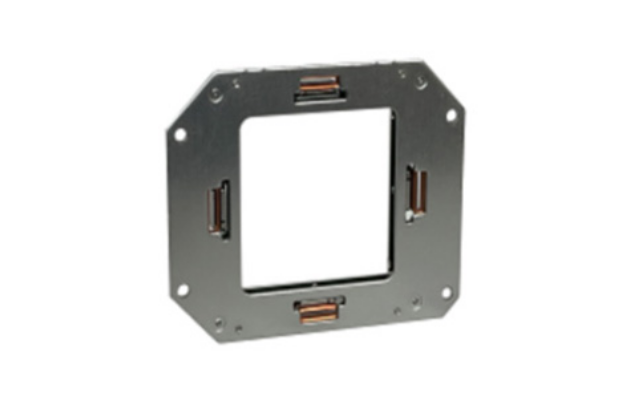
The per-axis displacement is identical — half a pixel, 2.7 µm on a 5.4 µm-pitch DMD — but the number of dwell states and the pattern they trace are not. Four positions visit the corners of a half-pixel square. Two positions oscillate along a single diagonal. Every downstream consequence follows from that geometry:
- Resolution arithmetic. Four states double both axes: 1920×1080 becomes 3840×2160. Two states move diagonally, so each axis gains √2: 2716×1528 lands at roughly 3840×2160. Same output, different starting chip.
- Subframe budget. At 120 Hz a frame lasts 8.33 ms. Split four ways, each state gets 2.08 ms, leaving under 0.8 ms for the move itself. Split two ways and each state gets 4.17 ms — identical hardware, twice the settling time.
- Transition count. 480 moves per second at 120 Hz with four positions, 240 with two. Coil heating, flexure fatigue, and audible noise all scale with that number.
- Calibration depth. Each state carries its own gain and offset trim in EEPROM. Four states means eight parameters to characterize per unit across temperature; two means four.
This is the practical core of the 4 position vs 2 position pixel shifter difference: it is a timing and calibration problem long before it is an optical one. A 4-position module running on a chip that only needs two states burns half its settle budget and a few tenths of a watt for resolution the chip already delivers.
|
DMD size |
Native resolution |
States required |
Per-axis shift |
Delivered output |
|
0.23" |
960×540 |
4 |
2.7 µm |
1920×1080 |
|
0.47" |
1920×1080 |
4 |
2.7 µm |
3840×2160 |
|
0.66" |
2716×1528 |
2 |
2.7 µm |
≈3840×2160 |
|
0.98" |
3840×2160 native |
0 (2 optional for 8K) |
— |
3840×2160 / 7680×4320 |
Note the asymmetry: two different chips, same 2.7 µm stroke, different state counts. The stroke is a property of pixel pitch. The state count is a property of how far the native resolution sits below your target. Min Aik, a Suzhou optical module manufacturer, builds both configurations on the same 5.4 µm-pitch platform, keeping the comparison on identical mechanics.
✅ Bottom line: Stroke comes from pixel pitch, state count comes from the resolution gap — so the chip decides the actuator, never the other way around.
2. How Do You Specify the Actuator for a 0.47 or 0.66 DMD Design?
Work backwards from pixel pitch and frame rate: three numbers decide the part — required per-axis stroke (pitch ÷ 2), states per frame, and settle time per state. The which pixel shift actuator for 0.47 and 0.66 DMD question is therefore an arithmetic exercise, not a catalog browse. It runs in six steps:
- Lock the target output, then count states. If native resolution is half your target on both axes, you need four states. If it is 1/√2 of target, two states are sufficient. Do not specify by actuator catalog tier.
- Set stroke with tolerance. 2.7 µm nominal, ±0.10 µm on delivered stroke. Position repeatability should hold within 3% of pixel pitch (0.16 µm); past that, one-pixel text starts to modulate visibly at the panel edge.
- Derive the settle budget. Require settle ≤40% of subframe time — 0.83 ms at 120 Hz with four states, 1.7 ms with two. Ask for step response measured at your actual mirror load and at 60°C, not the unloaded 25°C datasheet curve.
- Match the driver topology. Four positions need independent X/Y channels or a two-coil 2D flexure; two positions need a single diagonal axis and a cheaper single-channel driver. Overspecifying here is the most common hidden cost in a light-engine BOM.
- Check thermal and acoustic headroom. Four states add roughly 0.3–0.5 W of coil dissipation and lift the noise floor; keep the module at or below 22 dBA at 30 cm if the product sits near a viewer.
- Qualify at Nyquist, not at center. Ask for MTF50 at Nyquist, a phase-error map across the full panel, cross-talk between adjacent states, and drift from 25°C to 70°C.
|
Parameter |
4-position |
2-position |
|
States per frame |
4 |
2 |
|
Shift pattern |
corners of a half-pixel square |
single diagonal |
|
Transitions at 120 Hz |
480/s |
240/s |
|
Settle budget at 120 Hz |
0.83 ms |
1.7 ms |
|
EEPROM trim parameters |
8 |
4 |
|
Extra coil dissipation |
+0.3–0.5 W |
baseline |
|
MTF50 at Nyquist (equal build quality) |
5–10% lower |
higher |
|
Natural chip pairing |
0.23", 0.47" |
0.66" |
Where the two phase vs four phase pixel shifting image quality question actually bites is fine detail, not color or contrast. Subtitle strokes, 12-point UI text, and one-pixel CAD lines smear first when phase error accumulates, and a 2-position module averages that error over two states instead of four — which is why side-by-side reviews favor 2-shift designs at equal build quality. Min Aik publishes per-state phase-error data for both configurations, so the comparison rests on measurements rather than forum consensus.
For teams still weighing prototypes, the short version of which pixel shift actuator for 0.47 and 0.66 DMD to build first: order one custom 2-position and one 4-position sample against the same mirror load, run both at your target frame rate, and compare MTF50 at Nyquist. The data settles the argument in a week.
✅ Bottom line: Specify stroke from pixel pitch, settle time from frame rate, and driver channels from state count — then prove the choice with MTF50 at Nyquist, not with a catalog page.
FAQ
Q: Is the 4 position vs 2 position pixel shifter difference visible at normal viewing distance? A: Rarely on video content; consistently on fine text and fast horizontal pans. At 3 m from a 100-inch screen, a well-calibrated 2-position design shows cleaner subtitle edges and less shimmer during camera moves, while a 4-position design mainly reveals itself on single-pixel line patterns and test charts.
Q: Can a 4-position actuator run on a 0.66-inch DMD that only needs two states? A: Electrically yes, and it will produce an image — but you would be splitting the subframe four ways for no resolution gain, halving the settle budget and adding coil heat. The sensible answer to which pixel shift actuator for 0.47 and 0.66 DMD sizing is to keep the state count equal to the resolution gap. Min Aik supplies both configurations and will flag the mismatch during quotation rather than after tooling.
Q: Does the two phase vs four phase pixel shifting image quality gap widen at 120 Hz? A: Yes. Doubling the refresh rate halves subframe time, so a 4-position module drops to 2.08 ms per state and loses settling margin first. At 60 Hz the two designs are close; at 120 Hz the 2-position architecture holds its edge more easily.
Get the Matching Table for Your Chip
Send your DMD part number, target output resolution, and frame rate. The Min Aik engineering team returns a state-count recommendation, required stroke with tolerance, settle-time budget, and a phase-error comparison for both actuator configurations — factory-direct within two business days. Min Aik Technology (Suzhou) Co., Ltd. builds these modules in a Class 10,000 cleanroom under ISO 9001, RBA, and UL, alongside product lines that span Mobile Storage, Optical Galvanometer, and Medical Products assemblies — so the same OEM/ODM qualification process covers your optical, storage, and medical programs under one supplier.
Tel: 189-1555-3166
Email: [email protected]