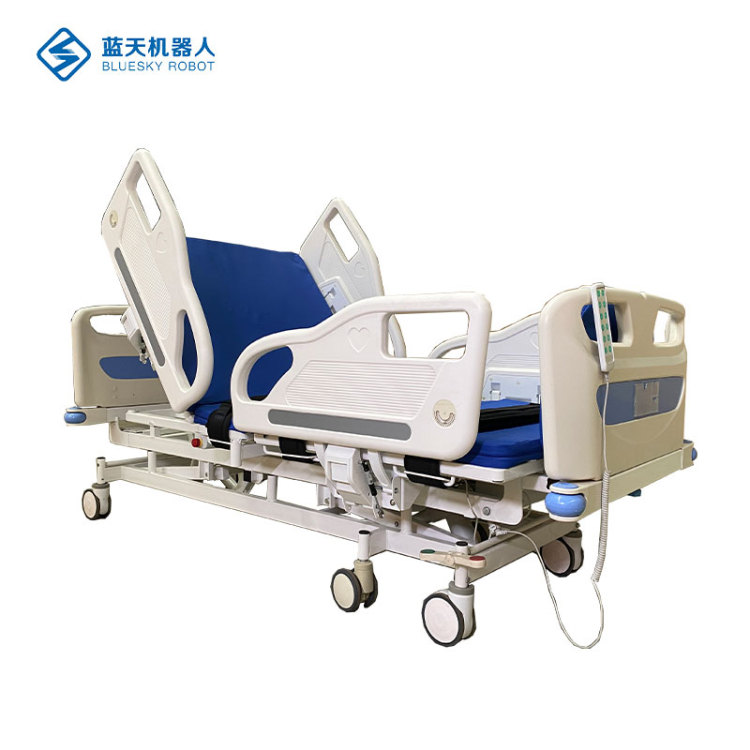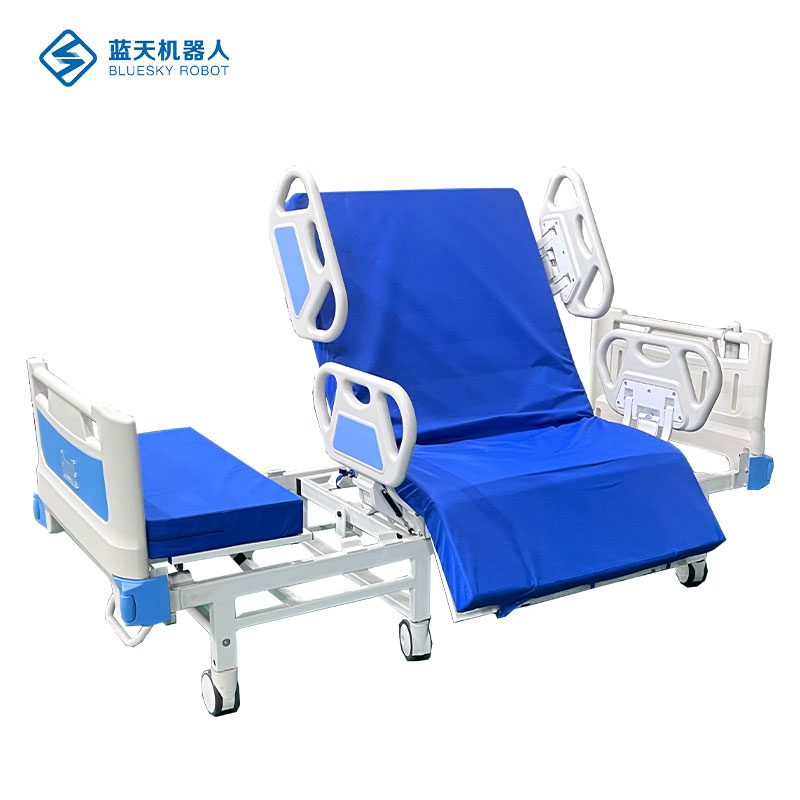
Function count is the most misread line on any medical bed quotation, whether it covers a 200-bed tender or a single hospital bed at home purchase. Two beds labelled "three function" can move in completely different ways, and a five-function bed placed in the wrong ward becomes a fall risk rather than a safety feature. Here is what each function actually costs, and how to allocate a fleet.
1. What do the third, fourth and fifth functions actually do?
Each added function is a separate actuator and a separate clinical claim, and only the third one — high-low — has a payback you can calculate.
|
Configuration |
Movement added |
Typical range |
Price effect (FOB) |
Where it earns its keep |
|
2-function |
Backrest + knee break |
Back 0–70°, knee 0–40° |
Baseline |
Mobile users who still transfer with light help |
|
3-function |
+ hi-lo (whole-deck lift) |
Platform 450–650 mm |
+60–110 |
Any bed where a caregiver performs personal care |
|
4-function |
+ back-knee synchronisation |
Linked, anti-shear |
+40–70 |
Immobile patients needing frequent repositioning |
|
5-function |
+ Trendelenburg / reverse |
±12–15° |
+150–300 over 3-function |
Step-down, post-op, palliative, ICU overflow |
Three things drive the price difference, and none of them is the frame:
- Actuator count. A 3-function electric nursing bed runs three linear actuators; a 5-function runs four or five, and the two lifting columns on a tilt-capable model carry far higher shear loads. Actuators are 25–35% of bill of materials, so this is where the premium sits.
- Control logic. Tilt models need interlocked control so the deck cannot tilt while the backrest is fully raised. Cheap implementations skip the interlock.
- Certification scope. A model with tilt is tested to a wider range of IEC 60601-2-52 loading conditions, which costs money once and then sits in the technical file.
The clinical argument matters more than the cost argument. Trendelenburg raises intraocular pressure and shifts preload; leaving a patient head-down without a protocol is an adverse event waiting for a report. Reverse Trendelenburg in a dementia ward, where a confused user can reach the handset, is worse — a tilted deck plus an unsteady transfer is how falls happen.
✅ Bottom line: Buy the third function every time and the fifth function almost never; hi-lo pays for itself in caregiver hours, tilt only pays off with a written protocol.
2. How do you allocate a fleet without over-specifying?
Map functions to patient acuity, not to bed count: a 200-bed facility rarely needs more than 15% five-function beds.
Run the arithmetic before the tender document — an electric medical bed tender written around one average unit price is how fleets end up over-specified. At a $150 premium per unit, converting 200 beds from 3-function to 5-function costs $30,000. If only 30 beds sit in units that genuinely need tilt, the correct purchase is 30 five-function and 170 three-function — a $25,500 saving that buys the mattresses, rails and spare-part kit for the whole fleet, which are the same three lines that decide whether a hospital bed fleet lasts eight years or five.
Four rules that hold up in practice:
- Hi-lo is not optional once a caregiver lifts. Set the deck so the caregiver's hands work at elbow height, roughly 750–800 mm. Caregivers who work bent are the ones who file injury claims, and one claim costs 15,000–40,000 — more than the hi-lo premium across 100+ beds.
- Back-knee synchronisation is the function buyers most often forget. Without it, the patient slides down the mattress as the backrest rises, and the shear is what produces sacral pressure injuries. If the patient cannot reposition themselves, this is the function to add before tilt.
- Tilt requires training, not just hardware. Budget a staff session and a written protocol; without them the function is either unused or misused.
- Match mattress thickness to the rail. A rail gap that is compliant with a 10 cm mattress becomes an entrapment risk with a 15 cm one. Specify the mattress with the bed, from the same supplier, and re-check the gap on delivery.
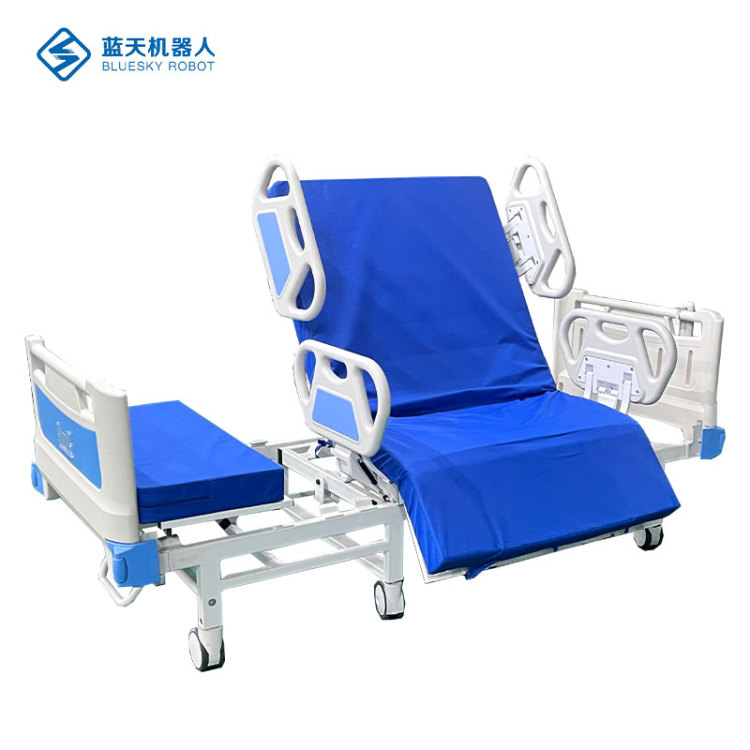
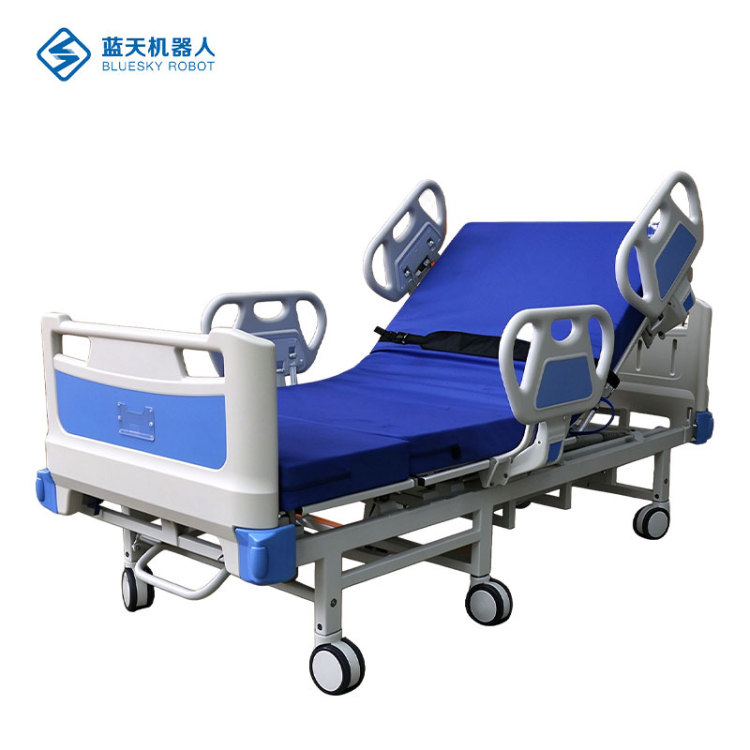
BLUESKY builds all three configurations on one platform, which is what makes a mixed fleet practical: the LT-33 for split-rail 3-function ward beds, the LT-45 for frame-integrated rails in care homes, and a 5-function rotating platform for high-acuity units — all at a 230 kg safe working load, roughly 50 kg above the 150–180 kg typical of imported home-care beds. The range is manufactured by Hunan Bluesky Robot Technology Co., Ltd. in Changsha, CE and ISO 13485 certified, and custom-configured for care-home groups, distributors and OEM buyers who need a single spare-part pool across a mixed fleet. BLUESKY quotes each configuration separately, so the 15% step-down allocation is visible in the numbers rather than buried in an average unit price.
✅ Bottom line: Specify hi-lo for the whole fleet, back-knee sync for immobile patients, and tilt only for the units with a protocol — then spend the saving on rails and mattresses.
FAQ
Q: Can functions be added to a bed after purchase? A: Not economically. Tilt needs different lifting columns and interlocked control; back-knee sync needs a different control box. Retrofitting costs 60–80% of a new bed and voids the certification scope, so buy the configuration once.
Q: Is a 5-function bed overkill for a hospital bed at home? A: Usually yes. Home care rarely has the staff to use Trendelenburg safely, and the money is better spent on a low minimum height for safe transfers, split rails and a pressure-redistribution mattress.
Q: What is a "4-function" bed, exactly? A: Definitions vary by factory, which is why you should ask for the movement list rather than the number. Most often it means back, knee, hi-lo plus back-knee synchronisation — but some suppliers count a tilt function as the fourth on an electric medical bed quotation. Get it in writing on the quotation, with ranges in millimetres and degrees.
CTA: Configure the Fleet, Not the Average
Send BLUESKY your bed count, the acuity mix of your units and your patient-weight range, and the team will return a configuration table — beds per function, per unit, with the price delta separated out — plus a mattress and rail combination that keeps the entrapment gap compliant. Hunan Bluesky Robot Technology Co., Ltd. manufactures electric nursing bed platforms from 2- to 5-function at its 20,000 m² plant, supports OEM/ODM configuration from 50 units per design, and ships samples in 7–10 days.