
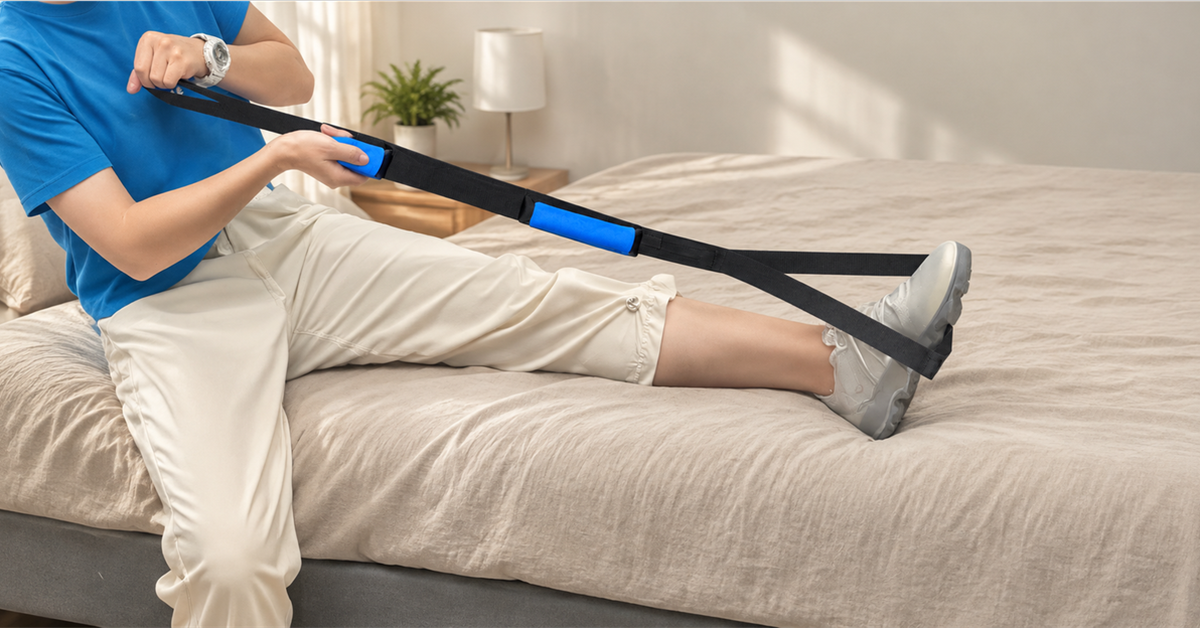
Which three points decide whether a mobility aid survives a year?
The stitch, the grip and the buckle. Everything else on a leg lifter, a gait belt or a bed ladder is
either decoration or a comfort detail. These three carry load, and each has one failure mode that
repeats across suppliers.
Component How it is loaded How it fails What to look at
Webbing stitch line Tension along the strap,
peeling at the seam
Stitch unravels from one
end
Bar-tacks and back-stitch
at each end
Grip / handle Bending and torsion at the
joint
Grip rotates or slides
on the webbing
Grip length and how it is
fixed
Buckle or loop Shear at the frame edge Webbing cuts through at
the corner
Rounded edges and webbing
thickness
The pattern is consistent enough to plan around. A strap that is simply stitched across and cut will
fail at the first stitch, because the load concentrates on one thread rather than spreading across a
bar-tack. It is the same physics as a button sewn with a single pass of thread.
A mobility aid fails at the stitch, the grip or the buckle — never at the surface.
How do you test them without a lab?
Three checks, all of them cheap, none of them requiring equipment beyond a fixed point and an hour.
They are the practical answer to how to inspect a leg lifter before placing a bulk order, and they
work the same way on every strap product in the range.
· Hang test: fix the strap, load it to the rated weight for fifteen minutes, then look for elongation
and stitch whitening
· Cycle test: fit, load and release twenty times in one sitting — failures that survive a single
demonstration appear by cycle eight
· Seam audit: cut one sample apart and count the back-stitch at each end; one pass is not a bar-tack
The gait belt stitching test for bulk import orders is the one buyers skip most often, usually
because the belt looks over-engineered. It is also the part that takes the whole body weight during
a transfer, in shear, at the buckle corner — the least forgiving place on the product.
The bed ladder webbing strength test for patient transfer follows the same logic but a different
failure point. Here the question is not the stitch, it is the anchor: whether the strap can slide
along the rail under a pull, and whether the grip stays where the patient expects it at 3 a.m.
Twenty cycles find what twenty photographs hide.
FAQ
The factory already has test reports. Is that enough?
Only if the report is linked to the lot you receive. A generic report proves the factory can build
one good sample; a lot-linked record proves the container you paid for was built to the same
setting. That is why how to inspect a leg lifter before placing a bulk order starts with the
paperwork and not with the pull test — the test only confirms what the record already claims.
What load should a gait belt be rated to?
Ask the factory to state a rated load and the method behind it, then test to that number yourself. A
figure without a method is a marketing claim, not a specification — and the same rule applies to
every bed ladder webbing strength test for patient transfer you are shown.
How many units should we sample?
Enough to cover every production line and shift in the run, kept as a sealed reference set. When a
complaint arrives six months later, that set is the only thing that settles the argument.
Load-tested at the stitch, not at the sample table
Homymusy builds these products around the three load points: bar-tacked webbing ends, grips fixed
rather than slid onto the strap, and rounded buckle frames. Every lot carries a gait belt stitching
test for bulk import orders and a pull record at the stitch line before packing, in seven stock
colours, private label from 300 pieces.