
Why is the discharge kit replacing the single-unit order?
Because the discharge timeline compressed. Total knee replacement moved out of inpatient-only status
in 2020 and total hip in 2021, and same-day discharge is now routine for a share of patients who
would previously have stayed two nights.
The clinical instruction did not change. The patient still cannot bend past ninety degrees, still
cannot reach the foot, still needs to lift the leg into bed. What changed is where the teaching
happens—at home, often by a family member who has never held a leg lifter.
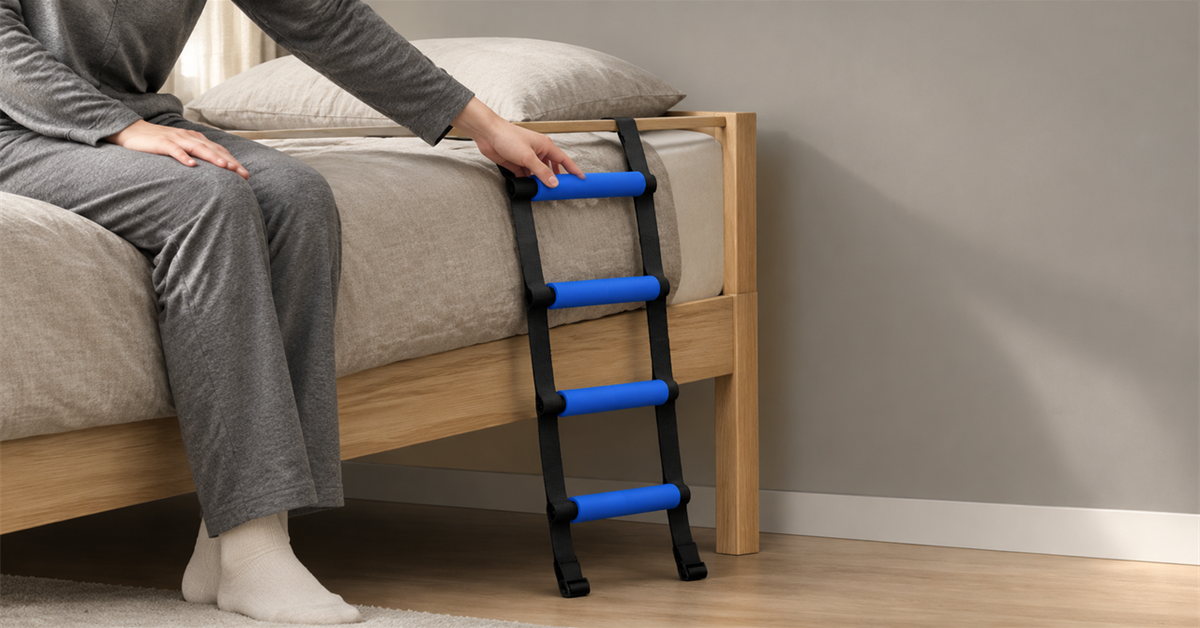
That is the operational problem a mobility aid kit for hip replacement recovery at home solves. A
leg lifter, a sock aid and a bed ladder are not three products to that household. They are one
sequence: lift, dress, reposition.
Bought separately, the three items arrive in three boxes with three instruction cards that disagree
on the same step. Ordered as a leg lifter and sock aid set for post surgery patients, they share one
card, one lot code and one size chart.
· One SKU and one lot code at goods-in, instead of three receipts
· One instruction card written for the sequence, not for the part
· One inspection pass, one supplier to chase when a seam fails
The kit is not a bundle built for margin. It is a response to a shorter teaching window.
What should a buyer check before switching to a kit?
Start with the load points, because a kit hides a weak part better than a single unit does. Three
components carry the patient's weight, and each fails in a predictable place.
Part What to check Typical failure
Leg lifter Loop stitching at the foot end; handle grip
under load
Loop pulls out at the seam
Bed ladder Webbing anchor at each grip; bed attachment
point
Strap slides on the rail
Gait / safety belt Bar-tacks at the buckle; webbing width Buckle tears through the web
Sock aid Terry lining bond at the rim Lining lifts, sock slips at step four
Then check the boring things. Instructions in the destination language, not machine-translated. A
size range that matches the market rather than the factory default. And a single lot code, so a
complaint traces back to a production run instead of a container.
Buyers sourcing bulk mobility aids for home health agencies usually add one more requirement: the
kit has to be repackable. Agencies routinely split a kit to send only what a patient needs, and they
will not buy a sealed box they cannot open cleanly.
Test the three load points, not the packaging.
FAQ
Is a kit cheaper than buying the parts separately?
Usually, but not by much. The saving sits in receiving, inspection and returns rather than in the
unit price, so ask for landed cost per kit instead of FOB price per piece. That is the number that
decides whether a mobility aid kit for hip replacement recovery at home is cheaper in practice.
Can we configure our own contents?
Yes, and most distributors do. The common build is a leg lifter and sock aid set for post surgery
patients, plus a bed ladder, with a dressing stick or shoe horn added depending on the market.
What is the minimum order?
300 pieces per style, with private label cards printed in your market's language.
Built as a sequence, not a catalogue
Homymusy supplies bulk mobility aids for home health agencies and DME distributors as a configured
kit or as separate lines: a 42-inch leg lifter with a reinforced foot loop, a terry-lined sock aid,
and a 160-inch bed ladder with four grips. Every load point is lot-tested at the stitch line before
packing, in seven stock colours, private label from 300 pieces.
If you are rebuilding a discharge programme for an agency or a distributor, send the current kit
list. We will quote the configuration and the landed cost per kit, not just the unit price.